
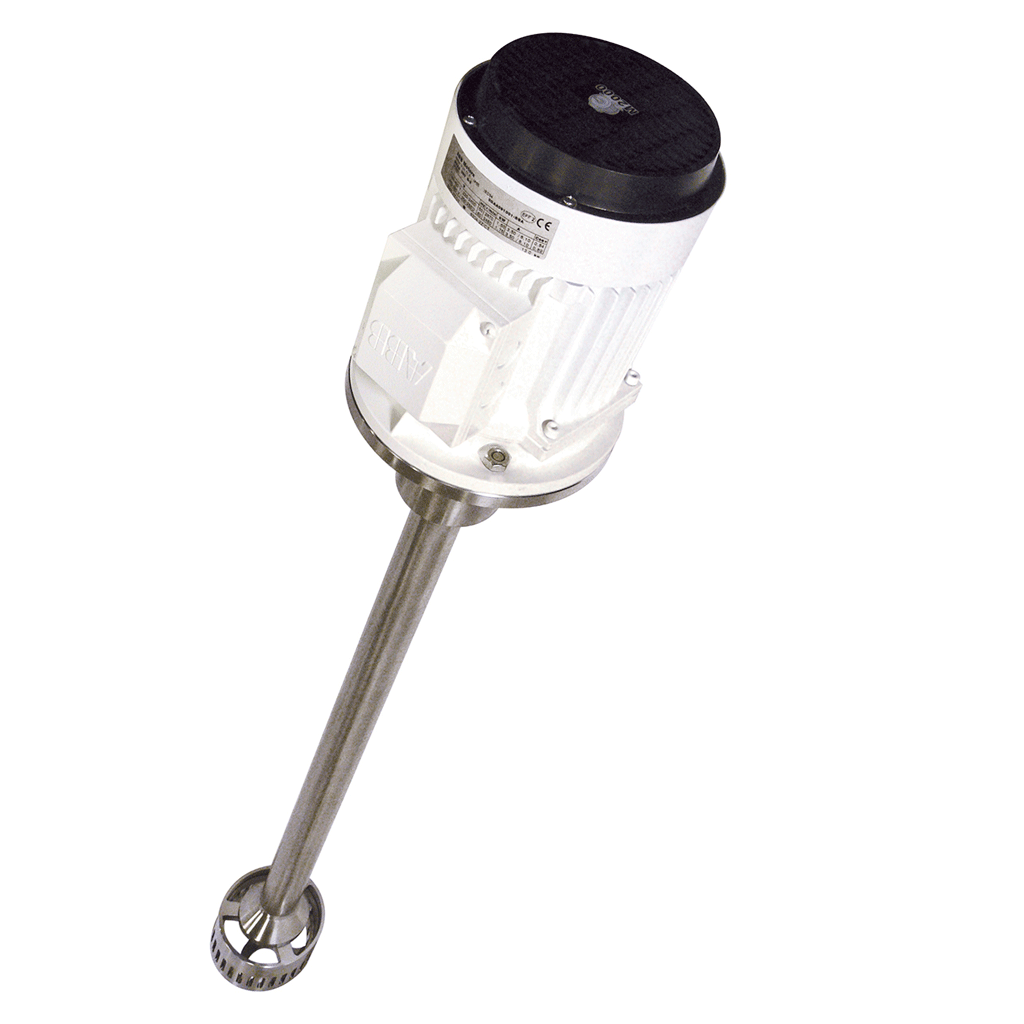
Emulsifiers and mixers · EMV · EMVT series
Vacuum emulsifier EMV / EMVT
Vertical high-shear vacuum emulsifier for high-viscosity products, up to 20,000 cP. It is mounted on the tank and can work under vacuum or overpressure without a cooled external mechanical seal. Single-stage (EMV) or two-stage (EMVT) version, from 0.55 to 18.5 kW.
- 20,000 cPMaximum product viscosity
- 0.55–18.5 kWMotor power, 7 sizes
- 1 or 2 stagesEMV or EMVT
- AISI 316LWetted parts
- Vacuum / pressureNo cooled external seal
- DIN 2576 / IECMounting flange
- Wetted parts in AISI 316L
- Works under vacuum or overpressure
- Single mechanical seal
- High level of hygiene
Prefer to speak to a technician? Call 972 58 20 40 or write to inoxmim@inoxmim.com
What is the EMV vacuum emulsifier for?
The EMV is InoxMIM's industrial emulsifier for producing emulsions and dispersions that require a high degree of shear in viscous products, up to 20,000 cP. The rotation of the impeller drives the product radially towards the slots in the head, where it is sheared and milled; as it leaves through the stator openings it disperses into the tank and creates a circulation that keeps bringing fresh product to the head until the mixture is homogeneous. This circulation pattern makes it possible to dissolve large quantities of powder.
Its sealing system allows it to work in non-atmospheric conditions (overpressure or vacuum) without a cooled external mechanical seal. For products that are difficult to mix there is the two-stage EMVT version, with a head adapted to each application. If you work at atmospheric pressure and want to change the head to suit the product, compare it with the EM vertical emulsifier.
This is the right equipment if…
- You need to emulsify or disperse viscous products, up to 20,000 cP: mayonnaises, creams, sauces.
- The tank works under vacuum or overpressure.
- You need to dissolve a lot of powder: gums, thickeners, sugars, salts or resins.
- The product is difficult to mix and would benefit from a custom two-stage head (EMVT).
Choose other equipment if…
- You work at atmospheric pressure with small or medium volumes and want to change the head (screen, slotted or perforated) depending on the product: the EM vertical emulsifier is better.
- You need to emulsify from the bottom of the tank: the EMF bottom-entry emulsifier is the better choice.
- You want to emulsify continuously and pump the product at the same time: the EML/EMLT inline high-shear mixer is the better choice.
- You only need to mix with low shear: the TURBINE vertical mixer is enough.
Applications by industry
Where the EMV is typically used:
Food industry
Emulsifying mayonnaises, creams and sauces, and dissolving sugars, salts, gums and thickening agents.
Cosmetics
Viscous high-shear emulsions and dispersions, with a homogeneous result.
Pharmaceuticals
Dissolving powders in pharmaceutical products, with wetted parts in AISI 316L.
Chemicals
Dissolving resins, salts and gases, and homogenising bulk containers (IBC).
Features and benefits
High shear
The impeller drives the product against the slots in the head, where it is sheared and milled before dispersing into the tank.
Viscous products
It works with viscosities of up to 20,000 cP and leaves a homogeneous product.
Vacuum or overpressure
The sealing system allows it to work in non-atmospheric conditions without a cooled external mechanical seal.
One or two stages
Single-stage EMV or two-stage EMVT, with a head adapted to products that are difficult to mix.
Adjustable head and turbine
The design of the head and turbine is tailored to each application.
Hygiene and maintenance
Few parts, easy assembly and disassembly, and a head and rotor designed to clean thoroughly.
Models in the series
Seven sizes with the same architecture, in EMV (1 stage) or EMVT (2 stages) versions. The first number in the code is the motor power in kW. We will help you choose the size according to the product and the tank.
| Model | Motor | DIN 2576 flange | IEC flange | Dimension L (mm) |
|---|---|---|---|---|
| EMV(T) 0.55-50 | 0.55 kW | DN50 | IEC 160 | 500 |
| EMV(T) 1.5-150 | 1.5 kW | DN80 | IEC 200 | 650 |
| EMV(T) 2.2-250 | 2.2 kW | DN80 | IEC 200 | 650 |
| EMV(T) 4-500 | 4 kW | DN150 | IEC 250 | 800 |
| EMV(T) 7.5-1500 | 7.5 kW | DN200 | IEC 300 | 1000 |
| EMV(T) 11-2500 | 11 kW | DN250 | IEC 300 | 1200 |
| EMV(T) 18.5-7000* | 18.5 kW | DN300 | IEC 350 | 1400 |
Data from the AGITMIM catalogue for the EMV model. Dimension L is as shown in the dimension drawing in the technical data sheet. *In the dimension table this model appears as EMV 18.5-10000.
Technical data
Materials
Wetted parts
AISI 316L stainless steel
Other materials (optional)
Hastelloy, AISI 904L, etc.
Process
Product viscosity
Up to 20,000 cP
Versions
Single-stage EMV · two-stage EMVT
Operating conditions
Atmospheric, overpressure or vacuum
Sealing
Seal
Single mechanical seal
External seal cooling
Not required
Motor and mounting
Power
0.55 to 18.5 kW
Motor flange
IEC type
Anchor flange
DIN 2576 or IEC, depending on model
Options and customisation
Control panel
Electrical control panel for starting and controlling the emulsifier.
Frequency inverter
To adjust the speed to the product and to each stage of the process.
Lifting system
Manual or automatic lifting to remove the emulsifier from the tank.
Other materials
Wetted parts in Hastelloy, AISI 904L or other materials for aggressive products.
Other connections
Flanges and connections other than the standard ones, to suit your tank.
Motor coating
Motor protection for washdown areas or demanding environments.
Other emulsifiers and mixers
Frequently asked questions about the EMV / EMVT vacuum emulsifier
What is the difference between the EMV and the EM emulsifier?
The EMV is designed for viscous products (up to 20,000 cP) and for working under vacuum or overpressure, and there is a two-stage version (EMVT) for products that are difficult to mix. The EM is aimed at small and medium volumes, with interchangeable heads (screen, slotted or perforated) chosen according to the product.
When should I choose the two-stage EMVT?
When the product is difficult to mix. In the EMVT the head design is adapted to each application to improve performance and shorten operating time. For standard emulsions and dispersions the single-stage EMV is enough.
Can it work in a vacuum or pressurised tank?
Yes. Its sealing system allows it to work under overpressure or vacuum without the need for a cooled external mechanical seal.
What viscosity can it handle?
Up to 20,000 cP, with a completely homogeneous result. It is suitable for mayonnaises, creams, sauces or solutions with gums and thickeners.
Is it suitable for dissolving powder in a liquid?
Yes. The circulation it generates in the tank makes it possible to dissolve large quantities of powder, such as sugars, salts, resins, gums or thickening agents. If you prefer to incorporate the powder outside the tank, into a recirculating liquid, take a look at the EMTB solid-liquid mixer.
How is it maintained?
With simple checks. The unit has few parts and is easy to assemble and disassemble; the mechanical seal and the condition of the head and rotor should be checked periodically, especially if the product is abrasive or crystallises.
Request a quote for the EMV / EMVT vacuum emulsifier
Equipment: EMV / EMVT vacuum emulsifier
Tell us what product you want to emulsify or disperse, its viscosity, the volume and dimensions of the tank, whether you work under vacuum or pressure and what solids you add. With these data we will indicate the model, the version (EMV or EMVT) and the mounting.