
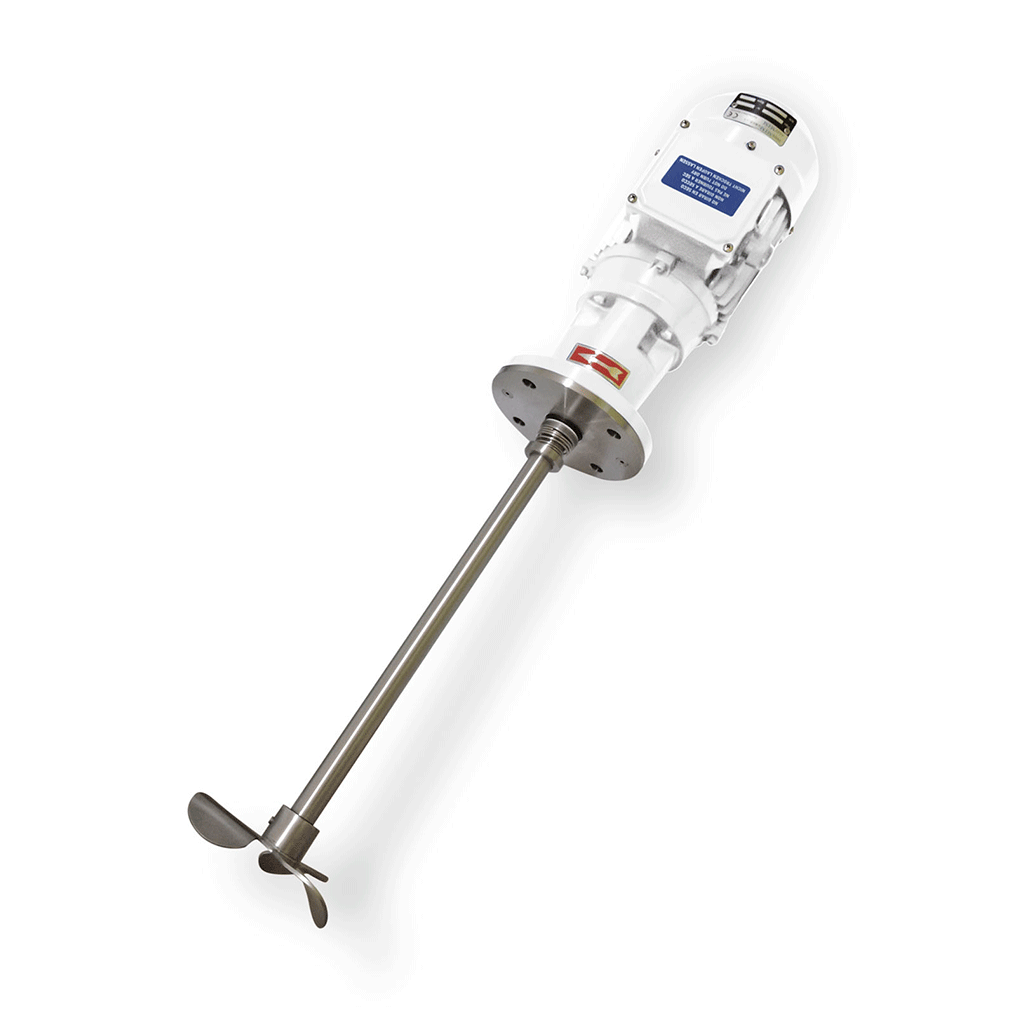
Side-entry agitators · LMDS series
LMDS compact side-entry agitator
Compact side-entry agitator with a small footprint for homogenising small and medium-sized tanks. It is fixed with a DN50 DIN 2576 flange, accepts a direct-drive motor or a geared motor and seals the shaft with a mechanical seal.
- 0.25–0.75 kWMotor power
- DN50DIN 2576 anchor flange
- 110–250 mmPropeller diameter
- AISI 316Wetted parts
- C/C/NSingle mechanical seal
- 17–24.5 kgWeight depending on model
- Wetted parts in AISI 316
- DIN 2576 flange
- C/C/N single mechanical seal
Prefer to speak to a technician? Call 972 58 20 40 or write to inoxmim@inoxmim.com
What is the LMDS compact side-entry agitator for?
Side-entry agitators are installed in the tank wall, below the liquid level, and move the product without taking up the top of the tank. They leave the lid free for other connections and manholes.
InoxMIM has designed the LMDS with a compact size and a configuration that can homogenise small and medium-sized tanks. It is fixed with a DN50 DIN 2576 flange, has a direct-drive motor or a geared motor and seals the shaft with a C/C/N single mechanical seal. The simplicity of its parts and the interchangeability of the agitation components make fitting, removal and maintenance easier.
This is the right equipment if…
- You need to homogenise a small or medium-sized tank from the side.
- You work in the food, cosmetics, chemical or pharmaceutical industry or in water treatment.
- You have to keep heavy particles in suspension or maintain products and reagents.
- You want an economical and simple side-entry agitator, with a DN50 flange and interchangeable parts.
Choose other equipment if…
- The tank is medium or large: an LMD/LECO side-entry agitator or a geared LECOR/LMRE is better.
- You want a portable agitator for several winery tanks: the LV wine agitator is better.
- The process calls for emulsifying or dispersing with high shear: an EM vertical emulsifier is the better choice.
- The tank does not accept a side flange: see the vertical agitators.
Applications by industry
Where the LMDS side-entry agitator is usually installed:
Chemicals
Maintaining products and reagents, and keeping heavy particles in suspension.
Water treatment
Agitation and homogenisation of reagents and mixtures in small and medium-sized tanks.
Food industry
Agitation and homogenisation of mixtures, including for heat exchange.
Cosmetics and pharmaceuticals
Mixing and maintaining products, with wetted parts in AISI 316.
Features and benefits
Compact size
Designed for small and medium-sized tanks.
DN50 DIN 2576 flange
Standard mounting: ø 165 mm flange with 4 bolt holes of ø 13 mm.
Direct-drive motor or geared motor
Two types of drive depending on the speed the process requires.
Single mechanical seal
Shaft sealing by a C/C/N mechanical seal; double seal as an option.
Interchangeable components
The agitation components are interchangeable to adapt the equipment to each mixture.
Simple fitting
Few parts and easy fitting and removal.
Models and dimensions
The LMDS series has five models with the same flange and the same shaft length. Contact us to choose the model and propeller.
| Models | Anchor flange | ø shaft (d) | ø propeller (D) | Shaft length (L) | Dimension H (flange–motor) | Weight |
|---|---|---|---|---|---|---|
| LMDS 0.25 · 0.37 · 0.55 · 0.75 · 0.37 R | DN50 DIN 2576 | 25 mm | 110–250 mm | 450 mm | 340–520 mm | 17–24.5 kg |
General dimensions of the series according to the AGITMIM catalogue; the catalogue gives ranges for the set of models. Flange: outside ø 165 mm, bolt circle ø 128 mm, 4 bolt holes of ø 13 mm at 90°.
Technical data
Materials
Wetted parts
AISI 316 stainless steel
Non-wetted parts
AISI 304 stainless steel, carbon steel and others
Drive
Type
Direct-drive motor or geared motor
Power
0.25 to 0.75 kW
Agitation
Propeller diameter
110 to 250 mm
Shaft diameter
25 mm
Shaft length
450 mm
Sealing
Type
Single mechanical seal
Seal faces
C/C/N
Option
Double mechanical seal
Anchoring
Flange
DN50 DIN 2576
Outside diameter
165 mm
Bolt circle diameter
128 mm
Bolt holes
4 × ø 13 mm at 90°
Weight
17 to 24.5 kg
Options and customisation
Control panel
For starting, stopping and protecting the agitator.
Double mechanical seal
As an alternative to the standard C/C/N single mechanical seal.
Variable speed drive
To adjust the agitation speed to each product.
Other materials
Materials other than the standard AISI 316 for the wetted parts, depending on the product.
Motor coating
External protection of the motor.
Other side-entry agitators
Frequently asked questions about the LMDS compact side-entry agitator
What is the difference between the LMDS models?
Mainly the motor power, from 0.25 to 0.75 kW; the catalogue also includes the LMDS 0.37 R model. All share a DN50 DIN 2576 flange and a ø 25 mm shaft 450 mm long, and have propellers from 110 to 250 mm depending on the model.
What size of tank can it agitate?
It is designed for small and medium-sized tanks. The model and propeller are chosen according to the volume, the shape of the tank and the product; for larger tanks there are the LMD/LECO and LECOR/LMRE side-entry agitators.
How is it fixed to the tank?
With a ø 165 mm DN50 DIN 2576 flange, with 4 bolt holes of ø 13 mm on a 128 mm diameter. The tank needs a side counter-flange below the liquid level.
What materials is it made of?
The parts in contact with the product are made of AISI 316 stainless steel. The non-wetted parts are made of AISI 304, carbon steel and other materials. Other materials are available on request.
Can it work with a double mechanical seal?
Yes. As standard it has a C/C/N single mechanical seal, and as an option it is supplied with a double mechanical seal for products or conditions that require it.
What needs watching during maintenance?
Above all the mechanical seal: product leaking along the shaft means it needs to be checked or replaced. The agitator should not be run with the propeller out of the liquid, because the seal would run dry.
Request a quote for the LMDS compact side-entry agitator
Equipment: LMDS compact side-entry agitator
Tell us the volume and dimensions of the tank, the product (viscosity, density, suspended solids), the flange position and the available voltage. With these data we will indicate the model and propeller.