
The difference between a centrifugal pump and a peripheral pump lies in how they move water. The centrifugal pump provides a high flow rate with medium pressure and is the one used in industry; the peripheral pump provides high pressure with a low flow rate and is typical for domestic use. If you need volume, choose centrifugal; if you need to lift clean water to a great height with a low flow rate, the peripheral pump is suitable.
When investing in pumping machinery, it is advisable to have all doubts resolved beforehand. Water pumps are no exception: before deciding, you must know what types exist, how they work, and what each one is used for.
Two of the most frequently consulted are the centrifugal pump and the peripheral pump, which at first glance seem similar but respond to very different needs. In this guide, you will see what each one is, how they differ point by point, and which one suits you according to your application.
What is a centrifugal pump?
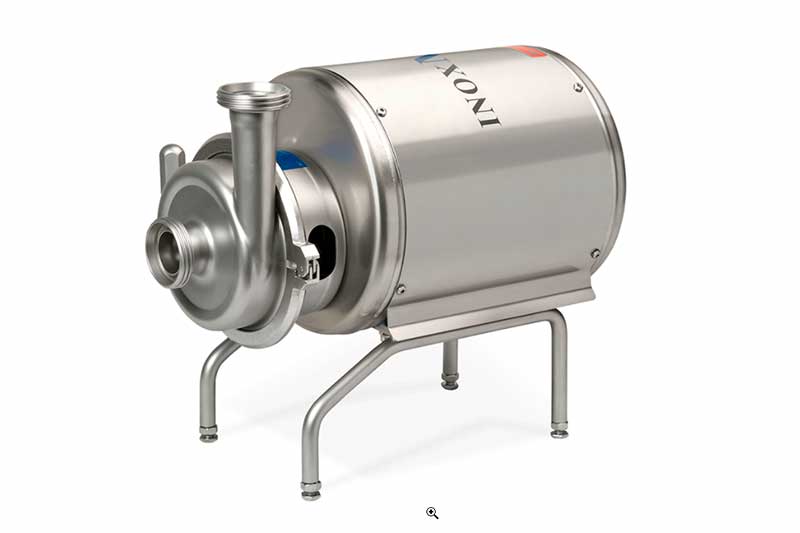
A centrifugal pump is a machine that transforms the mechanical energy of a motor into hydraulic energy by means of an impeller that rotates at high speed. This rotation generates a centrifugal force that drives the liquid from the center toward the periphery and sends it toward the outlet with a high flow rate.
They are the most widely used pumps in industry due to their simplicity, versatility, and low maintenance. They move large volumes of liquid, handle clean fluids and those with some suspended solids, and exist in versions adapted to each sector: industrial, food/sanitary, and hygienic.
They are used in drinking water distribution, process plants, desalination, mining, or petrochemistry, among many other applications.
Their advantages include a simple mechanism without articulated parts, direct electric drive, a constant flow rate for a given duty point (without the need for regulators), and a reduced size and weight compared to other technologies.
Maintenance is limited, in most cases, to bearings, mechanical seals, and gaskets, which extends their service life and lowers operating costs.
Table of contents
- What is a centrifugal pump?
- What is a peripheral pump and what is it used for?
- Centrifugal or peripheral water pump?
- Which to choose, a centrifugal pump or a peripheral pump?
- Frequently asked questions about our centrifugal pumps
- What is the difference between a centrifugal pump and a peripheral pump?
- What is a peripheral pump used for?
- Which is better, a centrifugal pump or a peripheral pump?
- What is the difference between a centrifugal water pump and a peripheral one?
- Which pump gives more pressure and which more flow rate?
- Which pump does the food, pharmaceutical, or chemical industry use?
- Contact us
- Frequently asked questions about our centrifugal pumps
What is a peripheral pump and what is it used for?
A peripheral pump (also called a regenerative turbine pump) is another type of water pump, but with a different operation: its impeller has small vanes on the periphery that drive the liquid in several successive steps. This allows it to reach very high pressures with small flow rates, something a centrifugal pump of the same size cannot achieve.
What is a peripheral pump used for? Primarily to lift clean water to considerable heights when flow rate is not the priority: irrigation of orchards and gardens, lifting water between floors, or pressurized domestic supply. However, it only accepts clean water, without abrasive particles or chemical products, and its maintenance is somewhat more delicate. Its great advantage is the price: it is usually much more economical, which makes it popular in the domestic sphere.
Difference between centrifugal and peripheral pump
This table summarizes the main differences between both pumps at a glance:
| Criterion | Centrifugal pump | Peripheral pump |
|---|---|---|
| Operating principle | Impeller that generates centrifugal force | Impeller with peripheral vanes (regenerative turbine) that drives the liquid in several steps |
| Flow rate | High | Low |
| Pressure | Medium, linked to flow rate | High with low flow rate |
| Lift height | Lower | Higher (suitable for >14 m) |
| Fluid type | Versatile: water, clean liquids, and those with some solids; sanitary and industrial versions | Only clean water, without abrasive particles or chemical products |
| Maintenance | Simple | More complex |
| Price | Higher | Lower (can cost up to half) |
| Typical use | Food, pharmaceutical, cosmetic, and chemical industry; processes and water distribution | Domestic: irrigation, clean water lifting |
| Does InoxMIM manufacture it? | Yes — FL-C range and FL-CH helical turbine | No (domestic use) |
Beyond the table, it is useful to understand the reason for each difference:
In practice, they are not rival technologies but complementary ones: they solve opposite pumping problems. Confusing them and choosing the wrong one is one of the most frequent causes of premature breakdowns, excessive electricity consumption, and results below expectations.
Related articles:
Centrifugal or peripheral water pump?
A very common doubt is the difference between a centrifugal water pump and a peripheral one, as both move water. The key is not the liquid, but the work profile: if you need to move large quantities of water (filling tanks, processes, distribution), the centrifugal pump is the option; if what you are looking for is to raise clean water under pressure with a modest flow rate (an elevated tank, long-distance irrigation), the peripheral pump fits better. In industrial installations, where flow rate, continuity, and compatibility with different fluids are almost always required, the centrifugal pump is the standard choice.
It is also worth remembering that the peripheral pump should only work with clean water. As soon as the water carries sand, fibers, or other particles, or when dealing with liquids other than water (oils, food products, chemicals), the peripheral pump is ruled out and the field becomes, once again, that of the centrifugal pump in its appropriate version for each fluid.
Which to choose, a centrifugal pump or a peripheral pump?
The decision should be based on a joint evaluation of your needs, not on a single factor. As a quick guide:
Here it is important to be clear: at InoxMIM we manufacture centrifugal pumps, not peripheral ones, because our focus is industry, where flow rate, hygiene, and reliability are needed. Our range covers everything from the simple centrifugal FL20C and the industrial FL30CI, to the food/sanitary FL50CI and hygienic FLUID versions, as well as the self-priming FL80CAI/FL90CAI.
And if your case is precisely the one usually solved by a peripheral pump —more pressure with low flow rate— we have a better industrial solution: the FL-CH helical turbine centrifugal pump, which reaches higher pressures while maintaining gentle product handling and all the robustness and sanitary guarantees of a process pump. If you tell us your flow rate, pressure, and fluid type, our technical team will recommend the exact model.
Frequently asked questions about our centrifugal pumps
With these concepts clarified, if you need technical advice or have more questions about our industrial pumps, contact our team: fill out the form, write to us at inoxmim@inoxmim.com, or call us at 972 58 20 40. We will be happy to help you.
Contact us