
Industrial pumps are divided into two main families—dynamic (centrifugal) and positive displacement (rotary). The right choice depends on the fluid, flow rate, pressure and sector. In this guide you will see what an industrial pump is, how it works, the types of industrial pumps we manufacture at InoxMIM (including water and hydraulic pumps) and the criteria for choosing the right one for you.
The use of pumps in industry is increasingly common, and choosing the right type makes the difference between an efficient process and one full of breakdowns. Success depends on several factors: the criticality of the process, pumping hours and the physical data of the fluid (type, flow rate, pressure, temperature and elevation).
At InoxMIM we design and manufacture pumping systems (FLUIDMIM range) for the food, pharmaceutical, cosmetic and chemical industries, so in this article you will find a clear classification of the types of industrial pumps, how each one works and how to choose the most suitable one for your application.
What is an industrial pump and how does it work?
An industrial pump is a machine that transforms the mechanical energy it receives from a motor (electric, thermal or other) into hydraulic energy and transfers it to a fluid, allowing it to be transported from one point to another, at the same level or overcoming elevation differences.
Its operation is based on a simple principle: the pump draws in the fluid through the inlet pipe and a moving element (an impeller, a rotor, a piston or a screw, depending on the type) imparts energy to it to drive it towards the outlet with the required flow rate and pressure.
Table of contents
In centrifugal pumps, for example, a rotating impeller generates centrifugal force; in positive displacement pumps, a chamber that fills and empties “pushes” a specific volume of liquid in each cycle.
Classification of industrial pumps
Although there are dozens of models, all pumps are grouped into two main classes according to how they transfer energy to the fluid:
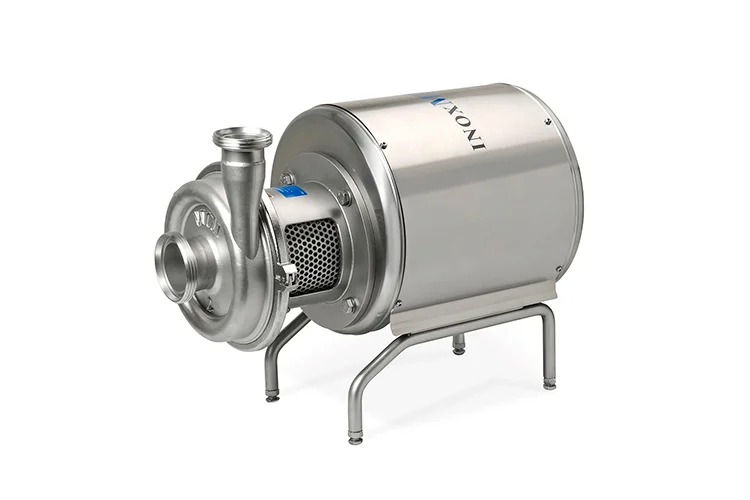
The following table summarizes the essential differences to guide your choice:
| Criterion | Dynamic pumps (centrifugal) | Positive displacement pumps |
|---|---|---|
| Principle | Centrifugal force of an impeller | Fixed volume displaced per cycle |
| Flow rate | High and constant | Proportional to rotation speed |
| Pressure | Depends on flow rate | High and stable |
| Viscosity | Low-viscosity fluids | Highly viscous fluids |
| Solids / delicate products | Limited | Very suitable |
| Examples of use | Water transfer, clean liquids | Creams, honeys, purées, viscous chemicals |
Types of dynamic pumps (centrifugal)
Centrifugal pumps
They are the most widely used pumps in industry. They transform the mechanical energy of an impeller into kinetic and pressure energy on an incompressible fluid.
They are very effective for moving large flow rates of liquid and working with low-viscosity fluids, which is why they are used in chemicals, pharmaceuticals, food, beverages or cosmetics. At InoxMIM we have industrial versions (FL20C, FL31CI–FL33CI) and sanitary/hygienic versions (FL51CI–FL53CI, FLUID) for applications that require CIP cleaning and food grade.
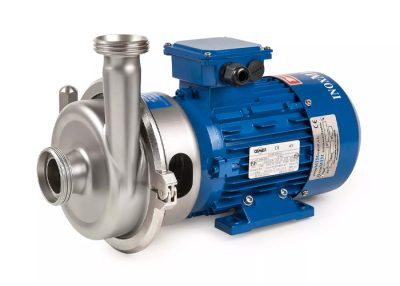
Their main advantages are:
Self-priming centrifugal pumps
Self-priming pumps (FL81CAI–FL93CAI) are centrifugal pumps capable of priming themselves, that is, evacuating the air from the suction pipe and starting to pump without the need to fill it beforehand. They are the solution when the pump is above the liquid level or when suction from tanks and vats is required.
Helical turbine centrifugal pump
The helical turbine centrifugal pump (FL-CH) incorporates a special impeller that allows it to achieve higher pressures with moderate flow rates than a conventional centrifugal pump of the same size, while maintaining gentle treatment of the product. It is a good option when more pressure is needed without resorting to a positive displacement pump.
Related articles:
Types of positive displacement pumps
These pumps guide the fluid along its entire path, increasing and decreasing the volume of a chamber to achieve suction and discharge. They are the best option when the product is viscous, sensitive to shear or contains solids. At InoxMIM all our positive displacement pumps are rotary:
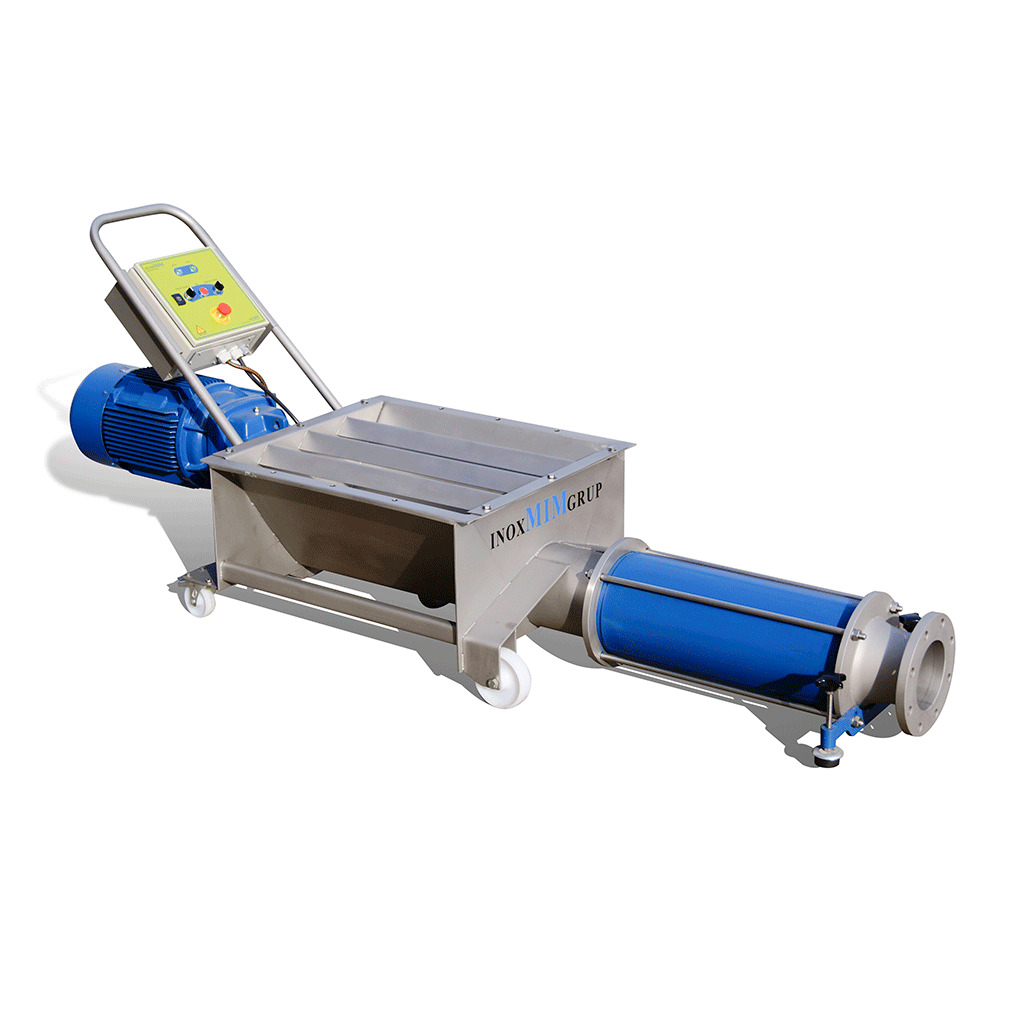
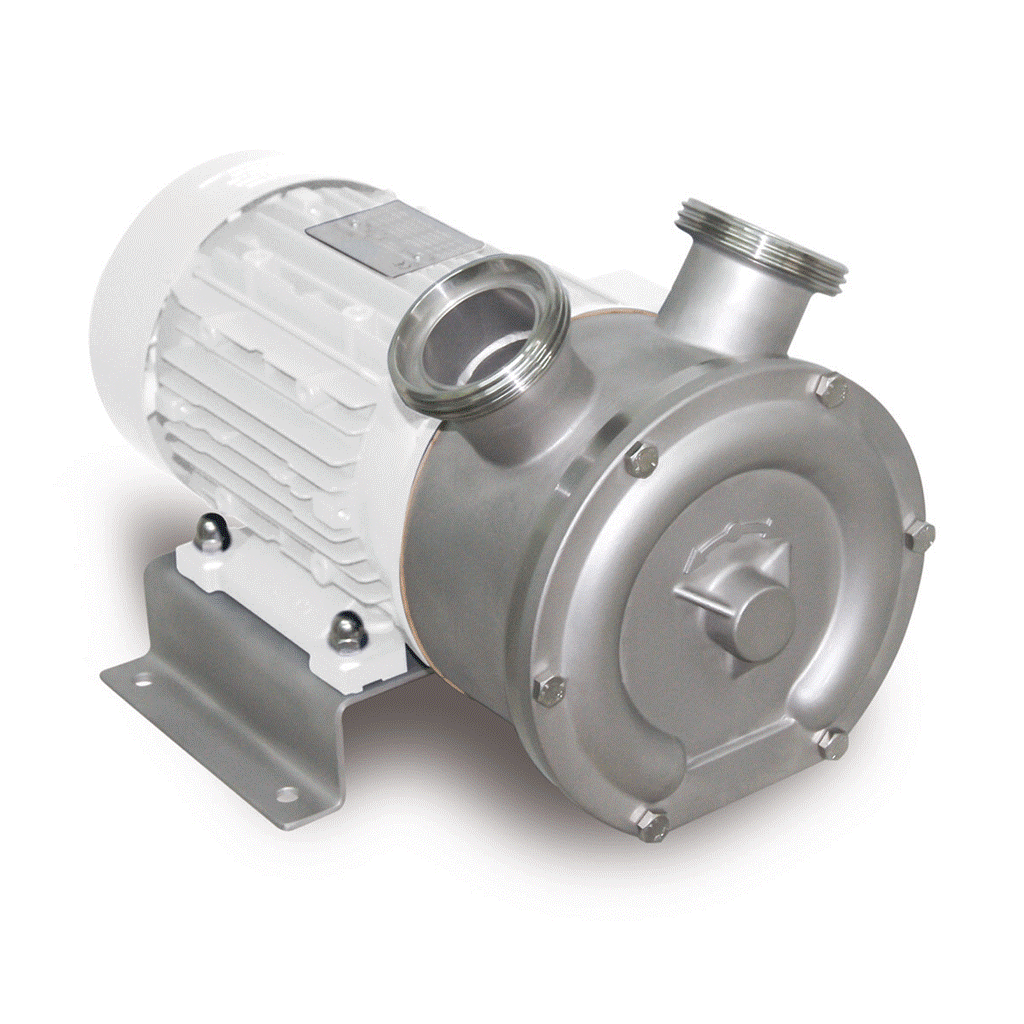
Rotary pumps are also known as rotatory pumps, and together with the rest of this class they form the group of mechanical positive displacement pumps.
Water pumps and industrial hydraulic pumps
Two terms generate many doubts in searches, so it is worth clarifying them:
How to choose the right industrial pump
There is no universal “best pump”: there is the most suitable one for each process. These are the decisive factors:
| Factor to assess | What you should consider |
|---|---|
| Type of fluid | Viscosity, presence of solids, abrasiveness, sensitivity to shear, temperature and corrosiveness. |
| Flow rate and pressure | Those required at the process working point. |
| Hygiene and regulations | In food, pharmaceuticals and cosmetics, sanitary designs and CIP cleaning are required. |
| Process continuity | Operating hours and criticality: a continuous process requires greater reliability. |
| Materials and chemical compatibility | The stainless steel and seal elastomers must be compatible with the fluid. |
| Suction and NPSH | Checking the available suction head prevents cavitation and extends equipment life. |
Quick guidance by use case (InoxMIM range):
| Need / use case | Recommended pump |
|---|---|
| Water and clean liquids, high flow rate | Centrifugal (FL-C) |
| You need priming or suction from a tank | Self-priming centrifugal (FL-CAI) |
| More pressure with low flow rate | Helical turbine centrifugal (FL-CH) |
| Viscous or delicate products (creams, honeys, purées) | Helical or lobe |
| Precise dosing | Gear (FL-ENC) or peristaltic |
| Corrosive, abrasive or sterile fluids, without mechanical contact | Peristaltic |
| Vacuum generation or gas entrainment | Liquid ring (FL-AL) |
Frequently asked questions about our industrial pumps
At InoxMIM we are manufacturers of this entire range of high-performance pumps for the food, pharmaceutical, cosmetic and chemical industries. If you have doubts about which pump fits your process, our technical team can advise you and even test feasibility in our test facilities. Call us at 972 58 20 40, write to us at inoxmim@inoxmim.com or fill out the contact form.
Contact us