Why a proper Installation defines your pump’s service life and efficiency

In process engineering, operational success lies in the details. The installation of a centrifugal pump is, perhaps, one of the most critical moments that will define the future performance of a pumping system.

For a plant manager or maintenance engineer, this procedure goes far beyond simply “connecting pipes” and tightening bolts; it is the foundational act that determines the efficiency, reliability, and safety of the entire operation.

An installation executed with professional precision is the best investment to guarantee the maximum service life of the equipment.

Conversely, a poor installation is the gateway to a cascade of hidden costs: from excessive energy consumption to premature failures in bearings and mechanical seals, destructive vibrations, and the dreaded ghost of cavitation.

In high-demand sectors, such as pharmaceutical, food, or chemical industries, where product integrity and personnel safety are non-negotiable, these risks multiply.

Content table

In this best practices guide, we will approach the centrifugal pump installation process not as a simple manual, but as an engineering strategy. We will divide the process into its three fundamental phases: Planning and Preparation, Mechanical Installation, and Commissioning.

Phase 1: Planning and preparation, the foundation for success

For the engineer or plant manager, the installation work begins long before the first tool is touched. This planning phase not only prevents problems, but actively designs the system’s efficiency and reliability. Meticulous site preparation and a clear understanding of the process requirements are the indispensable foundation for a successful installation.

Site analysis and installation requirements

Before positioning the baseplate, it is crucial to evaluate the environment where the pump will operate.
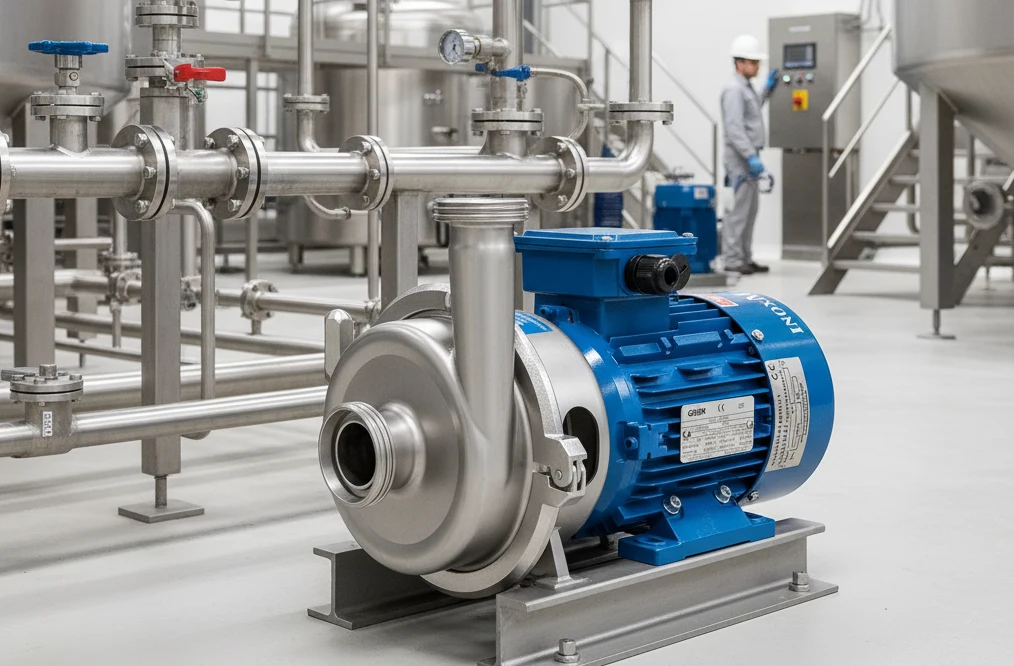
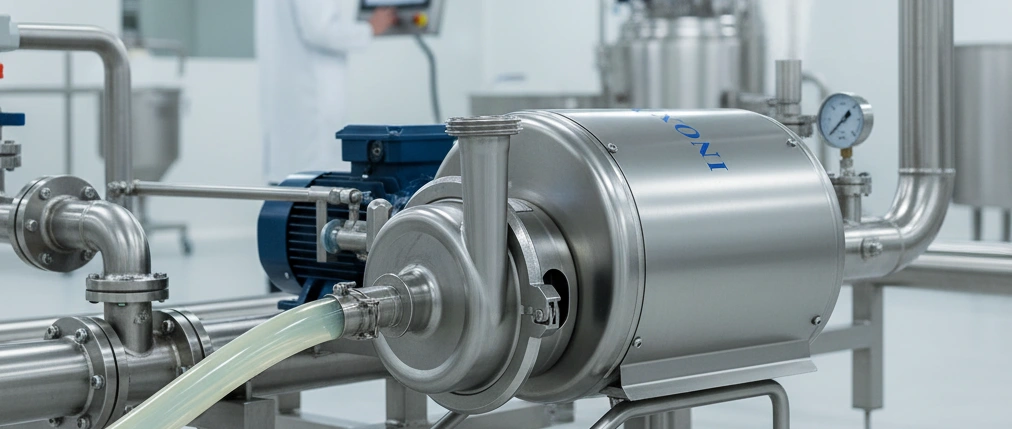
  • Foundation and space: The pump must be anchored to a solid, perfectly level foundation designed to absorb operational vibrations. A weak or uneven base is a guarantee of future problems. Likewise, plan for sufficient perimeter space.

    Saving a few centimetres today can cost hours of work in the future when a technician cannot comfortably access the motor for alignment, inspect the mechanical seal, or perform maintenance.

  • The key factor (NPSH): This is, perhaps, the most critical concept in centrifugal pump installation. The NPSH available (NPSHa) of your installation (determined by suction pressure, liquid height, and friction losses in the piping) must always be greater than the NPSH required (NPSHr) by the pump (a technical spec from the manufacturer).

    If the NPSHa is insufficient, the liquid will vaporize at the impeller inlet, causing the violent collapse of these bubbles. This phenomenon, known as cavitation, will destroy the impeller and internal components in a short time.

  • Safety and Environmental Requirements: The selected equipment must be consistent with the work environment. Will the pump operate in an area with explosion risk? It is mandatory to verify that the equipment complies with ATEX regulations. Is the process for the pharmaceutical or cosmetic industry?

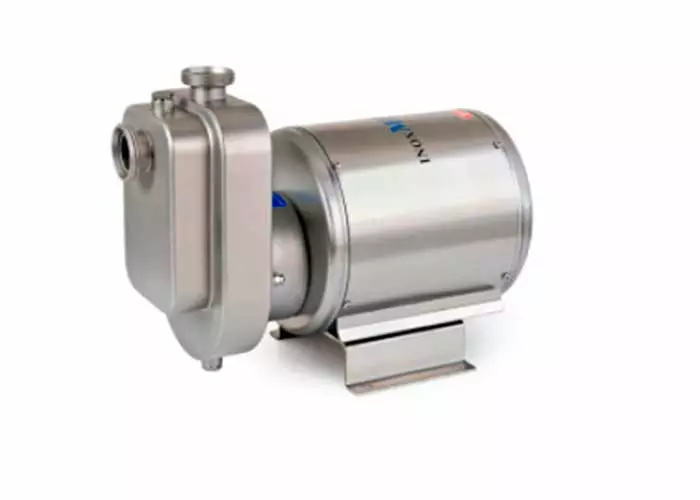
    A pump with a hygienic or sanitary design will be required, such as those in the FLUID range or the FL51CI model, which guarantee total cleanability and prevent product contamination. Conversely, for a general chemical process, a robust industrial pump like the FL31CI will be the appropriate choice.

Bomba centrifuga prueba
Prueba bomba centrigua 6
bomba centrifuga prueba 2

Phase 2: Mechanical installation, the assembly process

Once planning is complete, the physical assembly phase begins. Precision at this stage is what differentiates an elite industrial installation from a poor setup. Every millimetre of deviation here will translate into vibrations, premature wear, and efficiency loss.

Pump mounting, levelling, and alignment

The first step is to ensure the baseplate (the metal structure supporting the pump and motor) has perfect contact with the foundation.
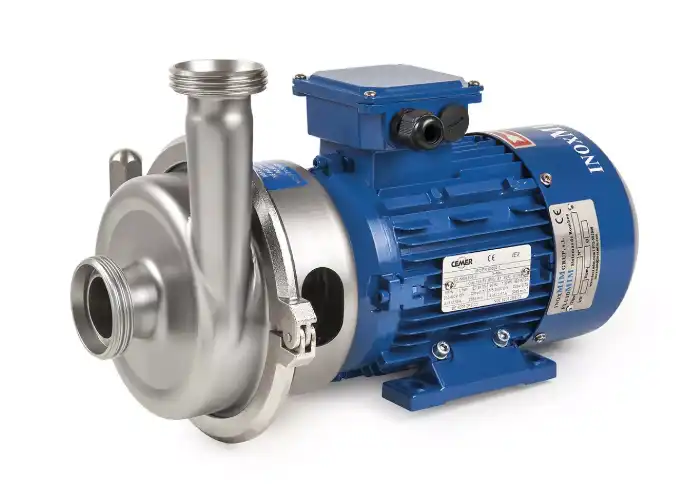
  • Fastening and levelling: Place the baseplate on the concrete foundation.

    Using levelling shims and a precision level, adjust the baseplate until it is perfectly level in all planes.

    Once levelled, grout is applied between the baseplate and the foundation to create a total support surface, eliminate gaps, and absorb vibrations.

  • Shaft Alignment: This is the most critical point for the long-term health of the bearings and mechanical seals.

    In pumps that are not close-coupled (i.e., where the motor and pump are separate units joined by a coupling), the shafts must be perfectly aligned.

    Misalignment, even by tenths of a millimetre, is the primary cause of vibrations and catastrophic failures.

      • Parallel Misalignment: The shafts are parallel but do not share the same centreline.
      • Angular Misalignment: The shafts meet at an angle to each other.
  • Although flexible couplings can absorb minimal misalignment, their function is not to correct it.

    The alignment must be nearly perfect, using precision tools like a dial indicator or, preferably, a laser alignment system.

Piping connection, the secret to a stress-free pump

Here lies the most common and costly error in pump installation. It is essential to follow this Golden Principle: The piping must be aligned to the pump; the pump must never be used to align the piping.

Forcing a pipe to match the pump flange transfers unacceptable stress and weight onto the casing. This strain deforms the pump, misaligns internal components, and causes almost instantaneous failure of the mechanical seal and accelerated wear on the bearings.

  • Suction Piping: This is the most sensitive line. It must be as short and straight as possible, avoiding elbows near the pump inlet.

  • Diameter: It is generally recommended to be one nominal size larger than the pump’s suction flange. This reduces fluid velocity and friction losses, directly improving the NPSH available (NPSHa).

  • Avoid Air Pockets: If a diameter reduction is needed in a horizontal suction line, always use an eccentric reducer with the flat side up. This prevents air pockets from forming at the top of the pipe, which can cause the pump to lose prime or cavitate.

  • Discharge Piping: Control and protection elements are installed on this line. The correct order, starting from the pump, is:

  • Check Valve: Prevents reverse flow of the liquid when the pump stops, protecting it from water hammer.

  • Isolation Valve (Gate or Butterfly): Allows the pump to be isolated for maintenance. It is also used partially closed during startup to ensure the pump begins operation near its Best Efficiency Point (BEP) and to avoid motor overload.

Remember: Both suction and discharge pipes must have their own independent supports near the pump, so that the pump bears absolutely no weight from the installation.

Phase 3: Electrical verification and commissioning

With the pump anchored, leveled, aligned, and connected to the piping, the next step is electrical integration and the first startup. This commissioning phase transforms the static installation into a functional, operating system.

Checking the direction of rotation

Before definitively coupling the motor to the pump (or before flooding the pump), it is absolutely vital to verify the motor’s direction of rotation. An electric motor connected with the incorrect phase sequence will spin in reverse.

  • The risk: Running a centrifugal pump backward is destructive. In the best-case scenario, it will barely move fluid and generate no pressure. In the worst case, it can severely damage the impeller and, in some mechanical seal or shaft thread designs, can cause the impeller to unscrew or the seal to fail catastrophically.

  • The safe method: With the pump uncoupled from the motor, perform a brief electrical “jog” and observe the motor shaft’s rotation direction. This must match the rotation arrow marked on the pump casing. If the rotation is incorrect, a qualified electrician must reverse two of the three power phases at the motor’s terminal box.

This is the most common operational error with centrifugal pumps. A standard centrifugal pump is not self-priming; it cannot pump air and needs to be completely full of liquid to function. Running it “dry” (without liquid) for more than a few seconds will generate extreme frictional heat in the mechanical seal, destroying it completely.

Unlike specific models designed for it (like the self-priming pumps FL81CAI, FL82CAI, or FL93CAI), the standard centrifugal pump must be primed:

  1. Ensure the discharge valve is closed.
  2. Fully open the suction valve.
  3. Open any bleed or vent valves at the top of the pump casing.
  4. Allow the liquid to completely fill the entire suction line and the pump casing, until liquid flows steadily from the vent.
  5. Close the vent. The pump is now primed and ready to start.
  • Valve sequence: Verify one last time that the suction valve is 100% open. The discharge valve should be partially closed (approximately 20-30% open). This reduces the load on the motor at startup and prevents it from operating in an unstable zone of its curve.
  • Startup and monitoring: Start the pump. Immediately, a technician must be alert for:
    • Noise and vibration: Listen for any abnormal noises (knocking, screeching) or unusual vibrations.
    • Leaks: Visually inspect the mechanical seal. There should be no leaks (at most, a minimal initial drip that should stop).
    • Electrical consumption: Measure the motor’s amperage with a clamp meter. It must be within the nominal values on the motor nameplate.
    • Pressures: Observe the suction and discharge pressure gauges. They should stabilize quickly.

Adjusting the operating point: Once the pump is running smoothly (a matter of seconds), slowly open the discharge valve until the desired flow rate or pressure is reached. Re-check the motor’s consumption to ensure it does not exceed the nominal rating.

inoxmim logo

Frequently asked questions and common error diagnostics

Even in the best installations, unforeseen issues can arise. This section addresses the most common problems an engineer or plant manager might encounter after installing and commissioning a centrifugal pump, offering a quick diagnosis.

This is generally an alignment, foundation, or cavitation issue. Noticeable vibration is the clearest alarm signal that something is wrong. The most likely causes are:

  • Misalignment: This is the #1 cause. The motor shaft and pump shaft are not perfectly aligned, creating immense frictional forces and wear.
  • Bad foundation: The baseplate is not level, or the grout was not applied correctly, allowing the pump to “dance” on its base.
  • Cavitation: The collapse of vapour bubbles (due to insufficient NPSH) generates a noise similar to “pumping gravel” and causes severe vibrations.
  • Imbalance: The impeller may be unbalanced from the factory (rare in quality equipment) or may have been damaged by a solid entering the pump.

Check three things: reverse rotation, incorrect priming (air in the pump), or a closed suction valve. This is a common commissioning problem. If the motor sounds normal, but there is no flow, systematically check:

  • Direction of rotation: This is the first check. If the pump spins backward, it will not move fluid.
  • Incomplete priming: This is the most likely cause. The pump is full of air, not liquid. You must stop it immediately and repeat the priming process, ensuring all air is bled from the casing.
  • Closed suction valve: Verify that the valve in the suction line is 100% open.

This is almost always due to pipe strain, misalignment, or dry running. The mechanical seal is the most precise and delicate component. It fails prematurely due to:

  • Pipe strain: This is the “silent killer” of seals. If the pipes force the casing, it deforms, misaligning the seal faces and causing the leak.
  • Dry running: Running the pump without liquid (even for seconds) overheats the seal faces, glazing them and destroying them.
  • Misalignment: The same vibration that damages the bearings also causes excessive shaft movement that the seal cannot compensate for.

It is operating off its operating point (BEP), the voltage is incorrect, or there is high friction from misalignment. If the motor draws more amps than its nominal rating (listed on its nameplate), the motor protection trips to protect it. The causes are:

  • Incorrect operating point: If the pump works with very little back-pressure (discharge valve too open), it “runs off its curve,” increasing the flow rate and causing the power consumption to spike.
  • Mechanical friction: Severe misalignment or damaged bearings increase mechanical resistance, demanding more force (and amps) from the motor.
  • Incorrect voltage: An erroneous electrical connection or voltage drops in the plant.

Yes, always. Even if the pump and motor (e.g., an industrial FL31CI model) come pre-mounted on a baseplate, the factory alignment is only preliminary. Transportation, crane unloading, and the anchoring process itself can (and often do) twist the baseplate enough to cause misalignment. The final precision alignment must always be done at the final site. This does not apply to close-coupled pumps (like the sanitary FL51CI models or the FLUID range), where the pump mounts directly to the motor flange, eliminating this risk.

A correct installation is an investment in reliability

An expert installation is not a cost; it is the primary guarantee for operational efficiency, process safety, and the maximum durability of your equipment. Ensuring proper planning, alignment, and commissioning protects your product and optimizes your production.

To ensure your next pumping project starts on the right foot, contact the InoxMIM engineering team. We will advise you on the optimal selection and installation of your FLUIDMIM pumping system.

Please do not hesitate to contact our sales department

To request information or resolve doubts about any of our equipment or solutions, do not hesitate to fill in the following form with your contact details and you will receive news from one of our sales technicians in a short space of time.