
The challenge of coalescence and phase separation in O/W systems
The industrial production of emulsified sauces, such as mayonnaise, salad dressing, or fine sauces, represents one of the most complex challenges in food process engineering.
Unlike simple solutions, an emulsion is a thermodynamically unstable system.
We are forcing the dispersion of two immiscible liquids (oil phase and aqueous phase) that naturally seek to separate to minimize their surface free energy.
For the plant engineer, the goal is not only to achieve the mixture but also to kinetically stabilize it long enough to cover the product’s shelf-life.
The destabilization phenomena that we must combat through agitation technology are mainly four:
At InoxMIM, we address these problems not only from a chemical perspective (emulsifiers) but also from the physics of fluids. Emulsion stability directly depends on the droplet size achieved during the mechanical shearing process. The smaller the diameter of the dispersed droplet, the lower the creaming rate and the higher the apparent viscosity of the system, creating a structural network that prevents coalescence.
To achieve this, conventional agitation is insufficient; specific shear energy is required to overcome the Laplace pressure of the oil droplets, “breaking” them into microns.
Droplet Size Reduction: The Importance of Shear Rate
The determining factor for transitioning from an unstable mixture to a bright, firm emulsion is the Shear Rate, measured in $s^$. In a process tank, a conventional propeller agitator generates excellent axial flow for suspension, but its shear rate is low (typically < 50 $s^$). This is insufficient to break oil droplets in a water and egg matrix.
To manufacture a stable mayonnaise, we need to introduce High Shear equipment that operates in ranges from 3,000 to 100,000 $s^$. This is where rotor-stator technology comes into play. The peripheral speed of the rotor (Tip Speed), which in our EMV or EML equipment can reach and exceed 20-30 m/s, generates extreme hydraulic turbulence.
When the fluid is driven into the head's slots, it is subjected to three simultaneous forces:
This process reduces the Droplet Size Distribution (DSD) to ranges of 200 to 50 microns in standard emulsions and below 10 microns in micronization processes.
It is imperative to understand that droplet size reduction is not linear with time; once the equilibrium size for a given power is reached, continued agitation only adds heat (detrimental to egg protein) without further reducing the size. Therefore, the selection of power and head geometry is a critical engineering decision.
Impact of Viscosity and Stabilizing Agents (Gums, Starches) on the Process
The rheology of sauces is complex. Most are pseudoplastic (their viscosity decreases with increasing shear rate) and thixotropic (they recover their structure at rest) fluids. This characteristic is vital for consumer experience: we want the sauce to flow easily out of the bottle but maintain its shape on the plate.
To achieve this texture, hydrocolloids (xanthan gum, guar gum) and modified starches are used, acting on the continuous phase (water) to increase its viscosity and immobilize oil droplets. However, the hydration of these texturizers presents an operational challenge: the formation of lumps or “fish eyes.”
If we use low-shear equipment, the powder encapsulates. If we use high-shear equipment incorrectly, we can break the polymeric chains of starches or gums, leading to an irreversible drop in final viscosity (a phenomenon known as over-shearing).
InoxMIM technology, especially in EML – EMLT equipment, allows for rapid and complete dispersion of these thickeners before the emulsification of the fat phase begins, or simultaneously, by controlling the energy input to maximize the stabilizer’s functionality without degrading it.
Furthermore, viscosity plays a role in mixing efficiency. As oil is added to mayonnaise, the system’s viscosity increases exponentially due to droplet packing (dispersed phase). Equipment that performs well at the beginning of the batch (liquid phase) may cavitate or lose pumping capacity at the end of the process if not designed to handle viscosities up to 20,000 cP or higher.
Critical Differences Between a Coarse Dispersion and a Bright, Stable Emulsion
How does an engineer distinguish a quality emulsion from a failed mixture at a glance? The answer lies in brightness and texture.
In addition to aesthetics, a fine emulsion has significantly higher viscosity for the same solids and oil content, allowing for cost optimization in formulation (using fewer thickeners to achieve the same texture).
Thermal stability and freeze-thaw resistance also improve dramatically. Therefore, investing in high-performance emulsification technology is not an expense; it is a direct strategy for reducing operational costs and quality claims.
Related articles:
Equipment Selection According to Process Line Design
The choice of emulsification equipment depends not only on the final product but also on the production line architecture: Do we operate in Batch or Continuous mode? What is the maximum viscosity at the end of the process? At InoxMIM, we offer a tiered range of solutions covering everything from premixing to micrometric refining.
Batch Processes: Versatility of Vertical Emulsifiers (EMV and EM Series)
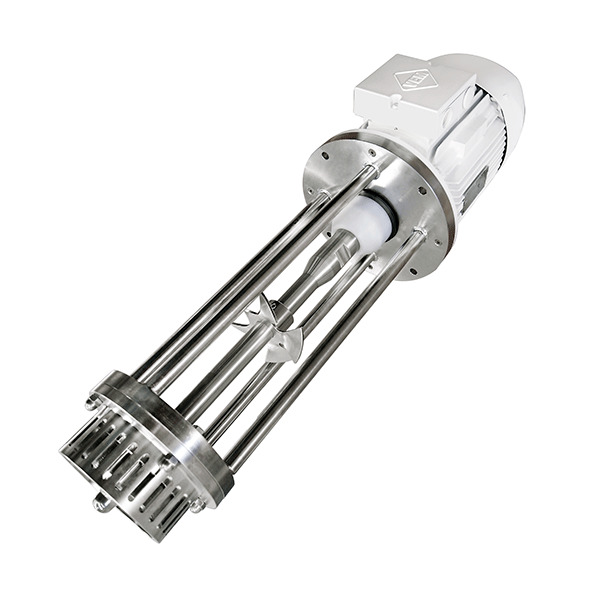
For flexible productions where different formulations are prepared in the same tank, the vertical emulsifiers EMV and EM series are the industry standard. These units are installed at the top of the tank and operate submerged.
Their operating principle is based on a stator head surrounding a high-speed turbine. The fluid is axially sucked in and radially expelled through the stator slots.
This configuration is critical for medium-viscosity sauces (up to 5,000-10,000 cP depending on the model and tank size), as it ensures that the entire tank volume repeatedly passes through the shear zone.
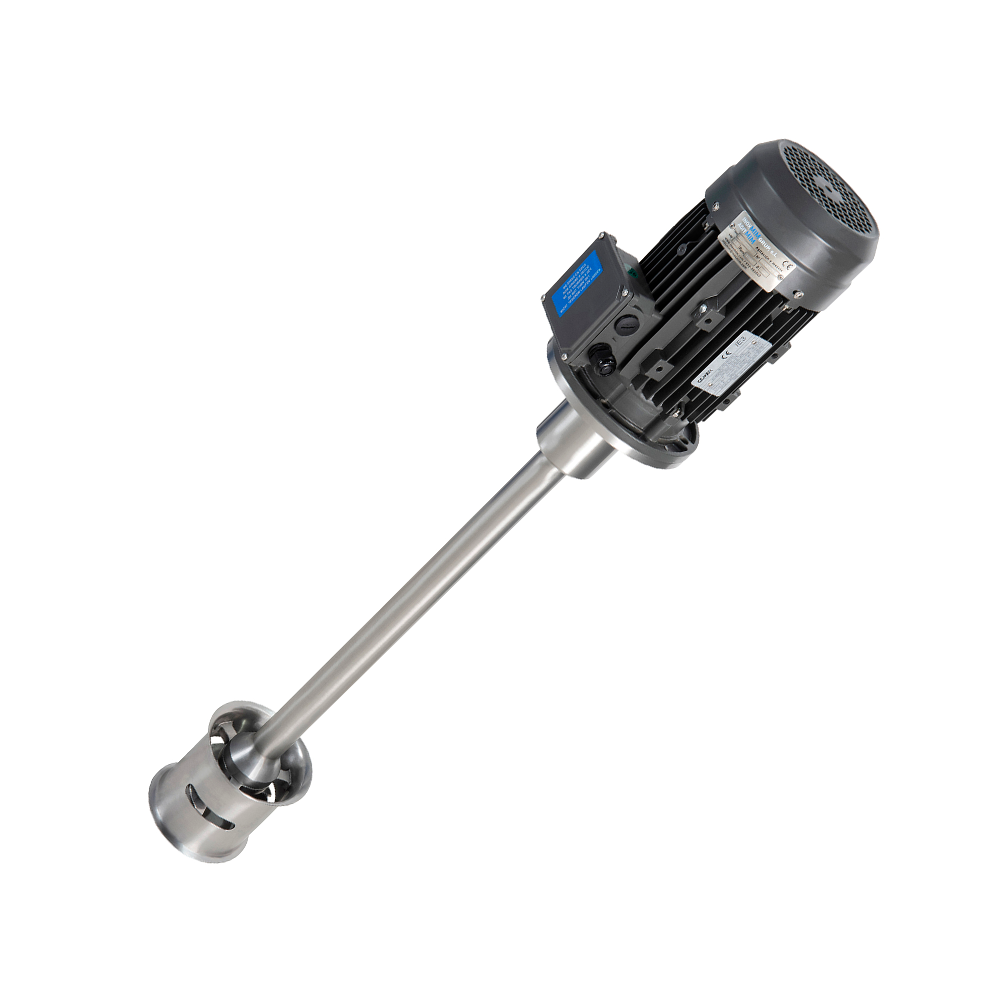
For applications requiring vigorous flow but moderate shear (e.g., sauces with particles or pre-emulsions), the TURBINE Vertical Mixer offers an efficient intermediate solution, generating strong suction and circulation without the energy consumption of a fine-slot emulsifier.
However, for light mayonnaise (low oil content) and fine sauces, the ability to configure the head is vital.
The EM equipment allows for interchangeable heads (sieve, slotted, or perforated) to adjust the shear level to the type of stabilizer or droplet size required.
High Viscosity Tanks: Synergy Between Bottom Emulsifier (EMF) and Anchor Agitator
When product viscosity increases significantly (e.g., in high-fat mayonnaise, dense creams, or pastes), a top-mounted vertical emulsifier may lose effectiveness due to a lack of product circulation in areas away from the rotor (drop in Reynolds number).
For these scenarios, the robust engineering solution is the EMF Bottom Emulsifier. Installed at the bottom of the tank, this equipment operates under hydrostatic load, which improves suction and minimizes air incorporation (a serious defect in dense sauces).
The optimal configuration in process reactors for sauces consists of a combined system:
This synergy ensures that 100% of the batch is processed and thermally homogeneous, preventing dead zones and localized overheating.
Continuous Processes and “Finishing”: Inline Homogenization (EML/EMLT Series) and Micronization (MICRO)
For high-production plants or when a premium texture with an extremely fine and uniform particle size is required, the process must move out of the tank.
| InoxMIM Equipment | Configuration | Max. Viscosity (approx.) | Main Application in Sauces | Key Advantage |
|---|---|---|---|---|
| TURBINE | Top Vertical | Medium-Low | Premixes, sauces with particles, vinaigrettes. | High circulation flow, gentle mixing. |
| EMV / EM | Top Vertical | Medium (< 10,000 cP) | Standard mayonnaise, gum dissolution. | Versatility, interchangeable heads. |
| EMF | Tank Bottom | High (with anchor) | Dense sauces, pastes, critical emulsions. | Operation with minimum volumes, no aeration. |
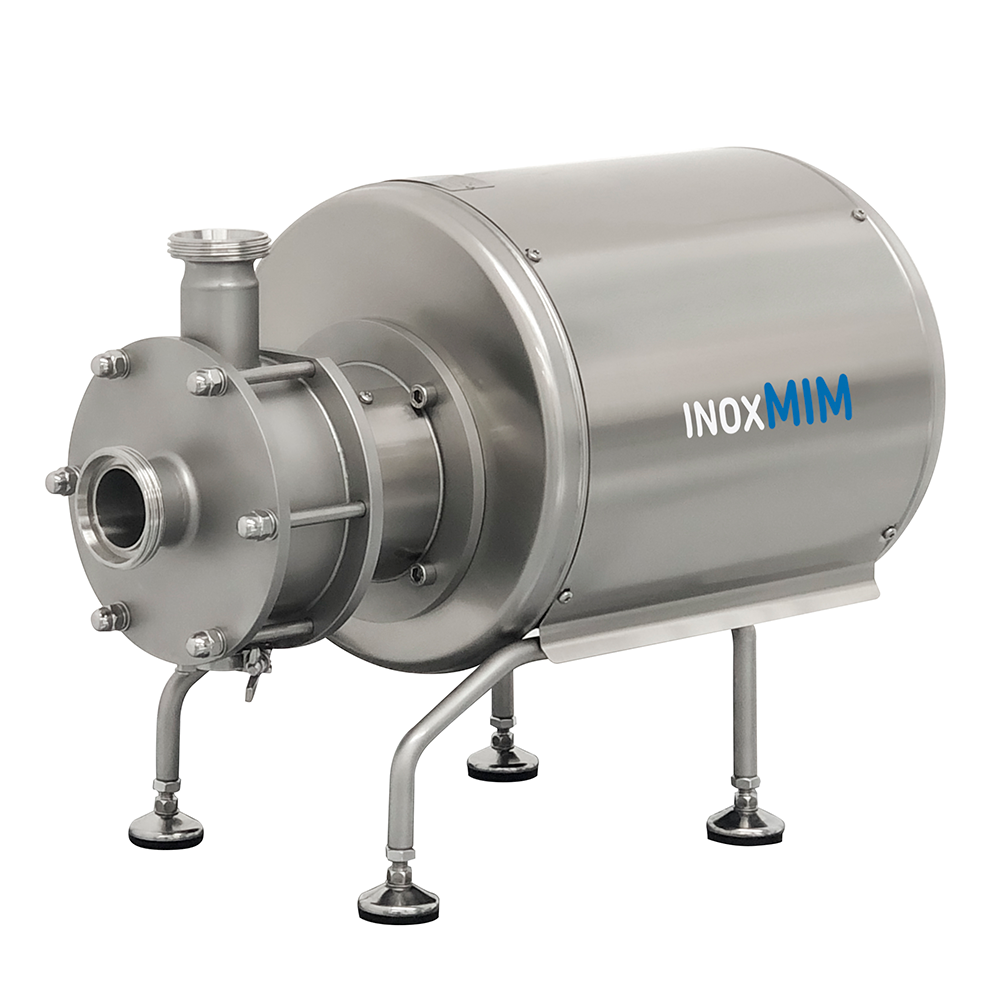
| EML / EMLT | Inline | Medium-High (pumpable) | Final homogenization, recirculation (loop). | Guaranteed single pass, pumping + shear. |
| MICRO | Inline (High Shear) | Medium | Premium sauces, ultra-fine textures (<10 µm). | Maximum shear, superior shine and stability. |
Sanitary Assurance and Efficiency in Sauce Production
The production of food emulsions, especially those based on egg or with neutral pH, carries an inherent microbiological risk (Salmonella, Listeria) that allows for no compromises. From an engineering perspective, mixing equipment must not only be capable of creating the emulsion but also be drainable, cleanable, and sterilizable with absolute reliability.
At InoxMIM, we apply hygienic design principles (EHEDG / 3A) and EC 1934/2004 food regulations in the manufacturing of our emulsifiers. This means eliminating dead zones, exposed threads, or geometries where product can stagnate and generate bacterial contamination foci.
However, food safety must align with operational efficiency (OEE). Equipment that requires manual disassembly for daily cleaning is an unacceptable “bottleneck” in a modern plant. Therefore, our technology is designed to integrate into automated CIP (Clean In Place) and SIP (Sterilize In Place) cleaning systems.
Hygienic Head Design and CIP Cleanability
Cleaning a rotor-stator head is a hydrodynamic challenge. The narrow slots and high rotation speeds that enable emulsification can also retain fatty residues if the design is not appropriate. InoxMIM equipment, such as the EM and EML series, feature surface finishes with roughness Ra < 0.5 µm (in sanitary/pharmaceutical versions) and open geometries that allow the turbulent flow of cleaning solutions (caustic, acid, hot water) to carry away any organic residue.
For critical applications, such as preservative-free mayonnaise or pasteurized sauces, shaft sealing is the critical control point.
Achieving a stable, bright, and safe mayonnaise or sauce is not by chance; it is the result of applying the correct fluid physics with the appropriate machinery. From premixing in the tank with a TURBINE, through high-shear emulsification with an EMV, to final inline refining with a MICRO, InoxMIM offers the technology to control every process variable: droplet size, viscosity, and temperature.
If your production line suffers from phase separation, inconsistent textures, or high processing times, contact our engineering department. We will analyze your formulation and design the mixing solution that guarantees the quality of your brand in every batch.
Contact us