
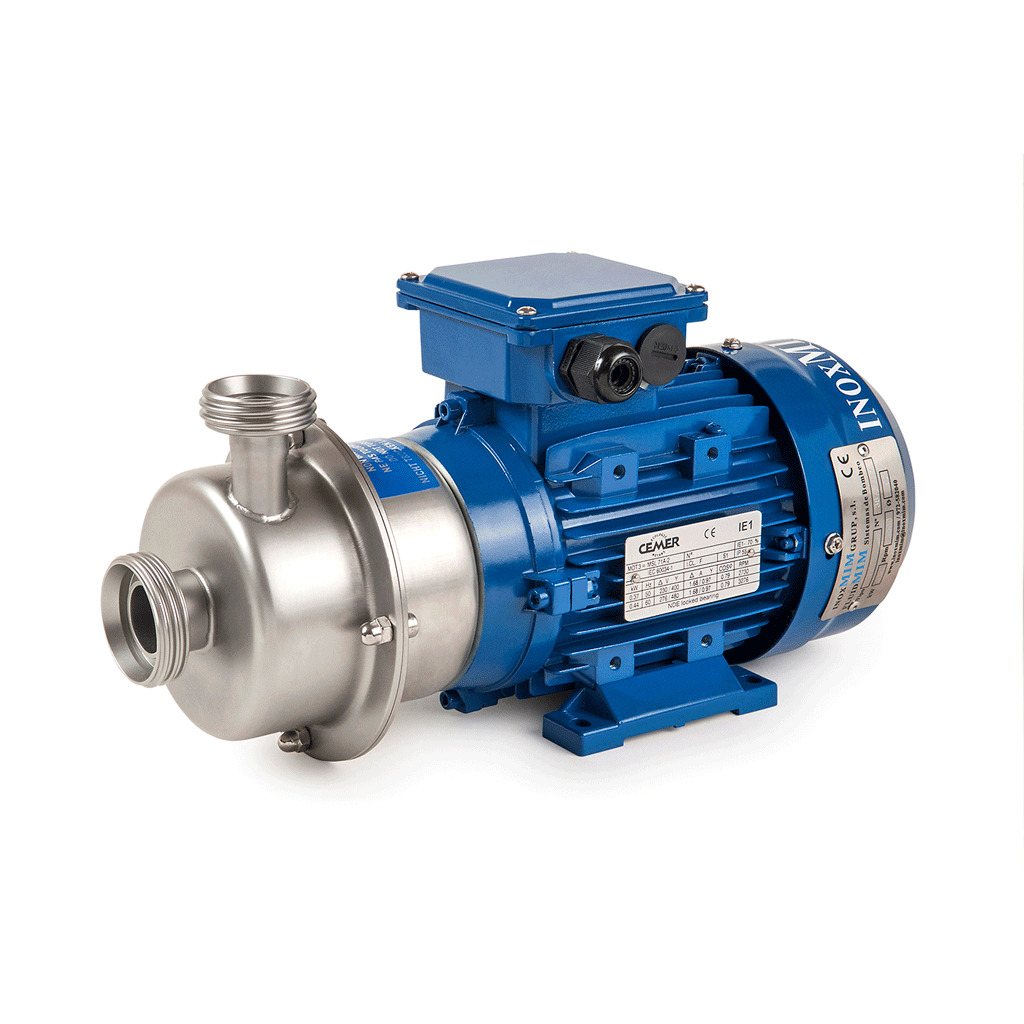
Food / Sanitary Centrifugal Pump FL50CI
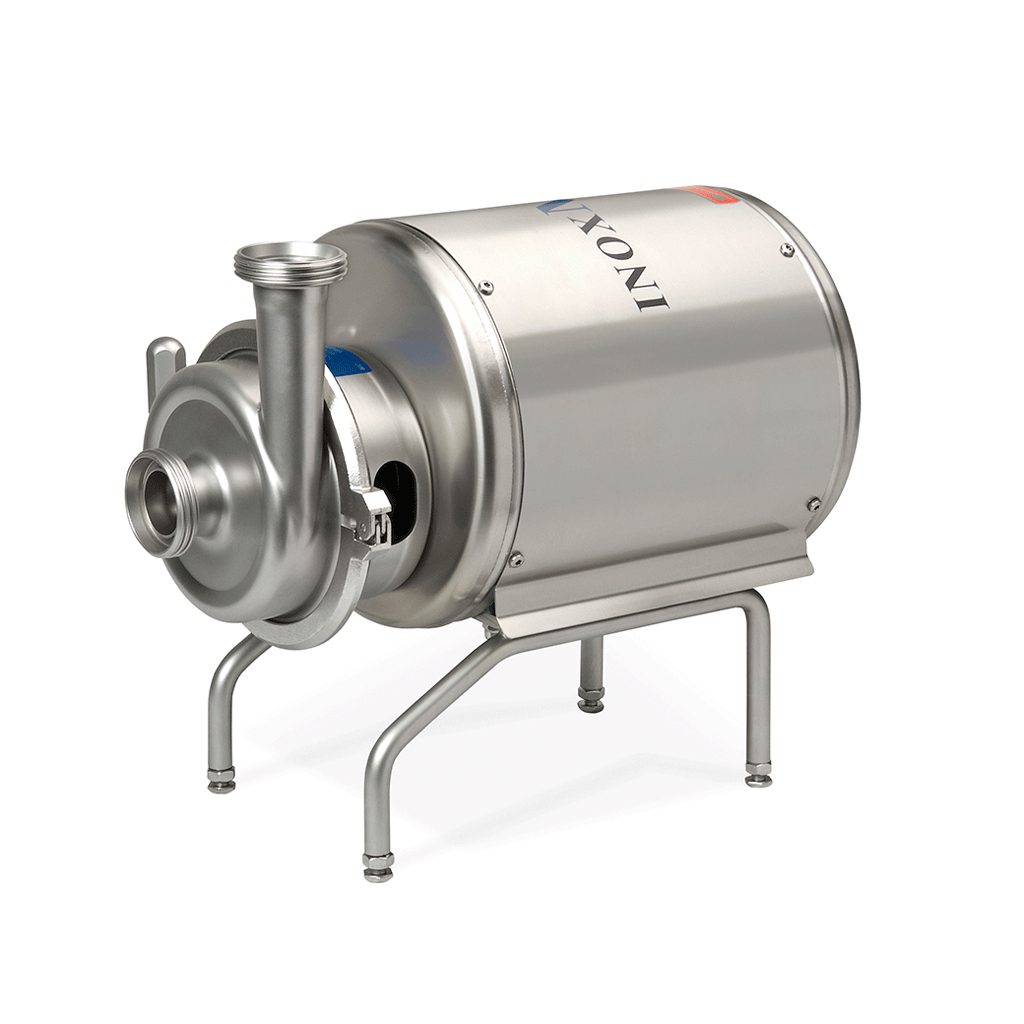
The reference sanitary range at InoxMIM. Open impeller centrifugal pumps with improved hygienic design (shroud and adjustable legs). The FL50CI series (FL51, FL52, and FL53) offers superior surface finishes (Ra 0.8 µm or 0.4 µm) to guarantee biological safety and cleanability in the food, cosmetic, and pharmaceutical industries, handling flow rates of up to 90 m³/h.
Technical specifications
- Max. flow rate: 90 m³/h (Full series)
- Max. head: 68 m.w.c.
- Material in contact: AISI 316 stainless steel (1.4404)
- Impeller type: Open
- Motor power: 0.37 kW – 22 kW (2900 rpm)
- Surface finish: Food-grade (Satin - Ra < 0.8 µm) / Sanitary (Polished - Ra < 0.4 µm)
- Connections: DIN 11851 (Standard)
The FL50CI Series represents the sanitary evolution of our pumping technology. Designed under the hygiene guidelines of EC 1935/2004, this range transforms the hydraulic reliability of industrial pumps into a solution suitable for the most sensitive processes.
The series consists of three scalable models (FL51CI, FL52CI, and FL53CI) that share a common architecture focused on asepsis: AISI 316 stainless steel body, motor protective shroud to facilitate external washdown, and mounting on adjustable legs, allowing for total cleaning of the floor under the equipment, eliminating the "black spots" of bacterial accumulation typical of flat baseplates.
The heart of the series is its open impeller. This geometry is critical in food and cosmetics for two reasons: first, it allows the passage of viscous fluids (such as creams, yogurts, or sauces) and particles (pulp, clots) without clogging; and second, it guarantees superior cleanability during CIP cycles, as the cleaning fluid impacts all surfaces without shadow zones, ensuring equipment sterilization after each batch.
- Surface Finishes (Roughness):
- Food-grade finish: Satin exterior and polished interior with Ra < 0.8 µm. Ideal for dairy, beverages, and general food applications.
- Pharmaceutical/cosmetic finish: Mirror polish with Ra < 0.4 µm. Mandatory for injectables, purified water (PW), and biotechnological products where biofilm adherence must be zero.
- Process connections: We supply the equipment ready to connect to your piping, whether with DIN 11851 (standard), CLAMP (Tri-Clamp for quick disassembly without tools), SMS, or RJT standards.
- Mechanical seals: From simple Graphite/Stainless Steel seals for water, to Silicon Carbide/Silicon Carbide combinations for crystallizable fluids (sugars, syrups) or abrasives (toothpaste). Elastomers available in EPDM (FDA) and Viton (FKM).
- Model FL51CI (Auxiliary Processes and Dosing): The compact unit. With motors from 0.37 to 2.2 kW, it is perfect for low flow rates (up to 20-25 m³/h) and medium heads (25 m.w.c.). Its precision makes it ideal for feeding filling machines, flavoring circuits, or micro-filtration.
- Model FL52CI (Standard Transfer): The plant's "workhorse". It is equipped with motors from 1.5 to 5.5 kW to move medium flow rates (up to 40-45 m³/h) with pressures of up to 4 bar. It is the standard pump for milk tanker unloading, wine transfer to filtration, or recirculation of medium tanks.
- Model FL53CI (High Performance): Pure hydraulic power. With motors from 4 to 22 kW, it reaches 90 m³/h and pressures of 6.8 bar. Its enlarged volute is designed for large process lines, plate pasteurizer feeding (overcoming the heat exchanger's pressure drop), and centralized CIP systems that require high flow velocity (turbulence) to clean the pipes.
- Dairy industry: Raw milk reception (where the open impeller treats the product gently), pumping of whey, cream, and ice cream mixes.
- Pharmaceutical and cosmetics industry: Transfer of purified water (PW), alcohols, body lotions, gels, shampoos, and medicinal syrups. (Ra < 0.4 µm finish is recommended).
- Food and beverages: Juices with pulp, liquid egg, brines, oils, vinegars, and low-viscosity sauces.
- Cleaning systems (CIP): Delivery of hot acidic and basic solutions. Its drainable design with no dead zones ensures there is no cross-contamination between the cleaning and production cycles.
If you need personalized advice, contact us
Related products
Industrial self-priming centrifugal pump FL90CAI
Self-priming Centrifugal Pump FL80CAI

Hygienic Centrifugal Pump FLUID
Food / Sanitary Centrifugal Pump FL50CI
Industrial Centrifugal Pump FL30CI
Simplified Centrifugal Pump FL20C