
Beyond flow rate: Preservation of product structure
In dairy process engineering, selecting pumping equipment based solely on the Q/H (flow/head) curve is an error that can compromise the final quality of the product.
Unlike the transfer of water or service fluids, pumping dairy matrices requires a deep analysis of the physical interaction between the impeller and the fluid.
The goal is not just to move the liquid from point A to point B, but to do so while keeping its organoleptic and physicochemical properties intact.
At InoxMIM, we understand that an incorrectly selected pump acts as an unwanted homogenizer, altering textures or causing irreversible phase separations. Therefore, the primary design variable is not power, but product integrity.
Dynamic viscosity and its variation (Milk vs. Curd vs. Yogurt)
The rheological behavior of dairy products varies drastically depending on the process stage. While raw milk, whey, or skim milk generally behave as Newtonian fluids —where viscosity remains constant regardless of the shear rate— fermented or concentrated products exhibit complex non-Newtonian behaviors.
Yogurt, curd, or high-fat creams are typically pseudoplastic (shear-thinning) or thixotropic fluids. Their apparent viscosity decreases under shear stress, but excessive agitation or turbulent pumping can irreversibly destroy the gel structure or protein network.
For low-viscosity fluids (such as milk or whey), sanitary centrifugal pumps, such as our FLUID range, offer efficiency and flow. However, for viscosities exceeding 500-1,000 cP, or where structure is critical, it is imperative to transition toward positive displacement volumetric technologies.
The problem of excessive shear and fat globule rupture
The “silent enemy” in dairy pumping is shear stress. A standard centrifugal pump operating at 2,900 rpm generates high peripheral speeds at the impeller, resulting in significant shear forces. While this is acceptable for cold raw milk, it can be disastrous for other product states.
Excessive mechanical impact causes the rupture of the fat globule membrane, releasing free fatty acids that are susceptible to oxidation and the action of native lipases, resulting in flavor defects (rancidity) and texture problems.
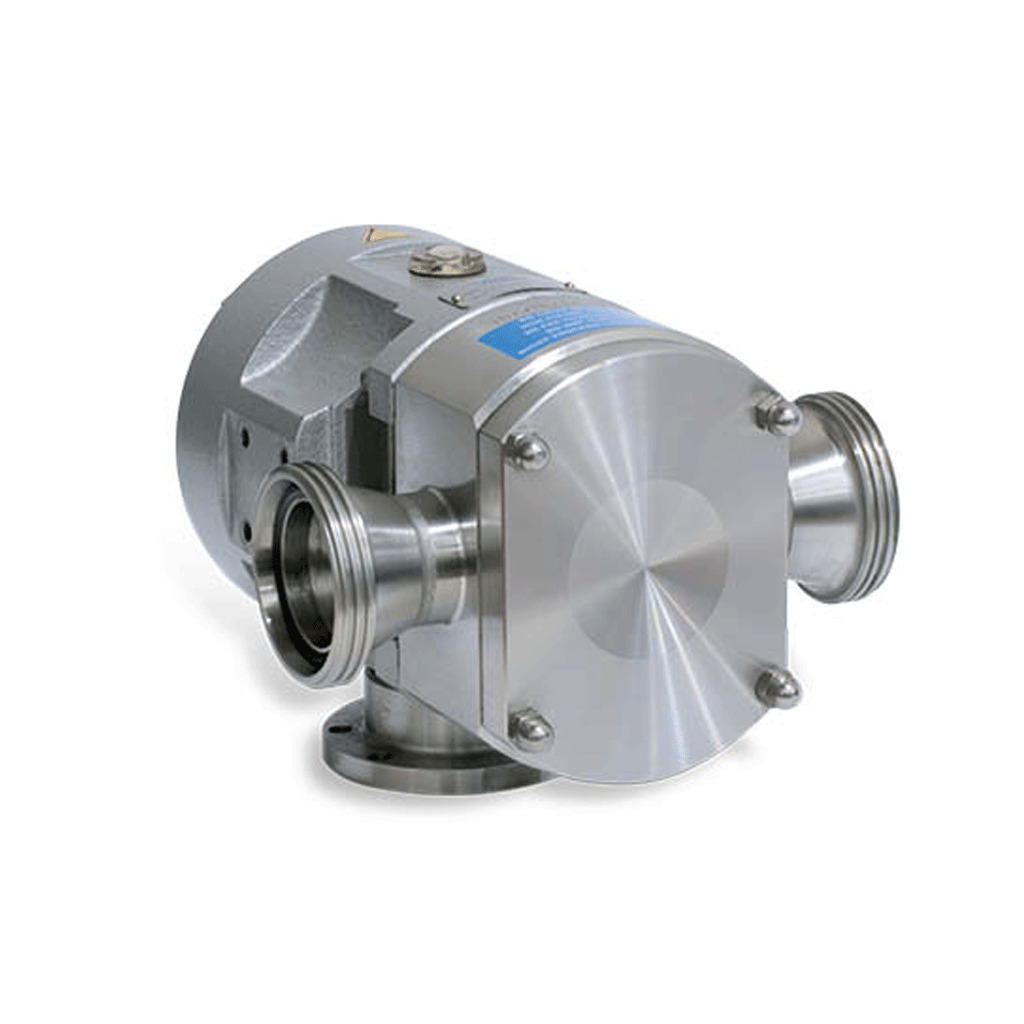
For sensitive applications, such as transferring curd prior to cutting or pumping whipping cream, it is crucial to select equipment that operates at low speeds and with wide pumping chambers, such as our lobe pumps FL–PRL or helical pumps FL–ERB, which transport the product in cavities without subjecting it to centrifugation or extreme turbulence.
CIP/SIP cleaning requirements and sanitary regulations (Ra < 0.8 µm)
In the dairy sector, bacteriological safety is the absolute priority. Any equipment installed in-line must strictly comply with design requirements according to EC Regulation No. 1935/2004, European regulations for food machinery design, and, in the most demanding cases, meet the hygienic design principles defined by standards such as EHEDG or 3A. This implies that pumps must be completely drainable and suitable for CIP (Clean In Place) and SIP (Sterilize In Place) processes without the need for disassembly.
From a construction perspective, this translates into the exclusive use of AISI 316L stainless steel for all parts in contact with the product, guaranteeing surface finishes with an average roughness of Ra < 0.8 µm.
This level of polishing is critical to prevent the formation of bacterial biofilms and the accumulation of protein deposits (milk stone). Furthermore, mechanical seals must be sanitary, balanced, and designed to avoid dead zones where the product could stagnate and microorganisms could proliferate.
Related articles:
Pumping technologies according to the critical application
At InoxMIM, we approach the dairy process line by segmenting needs according to the fluid rheology at each stage. There is no “universal pump”; there is the right technology for the specific viscosity and shear sensitivity of each sub-process. Below, we break down our engineering applied to the critical production phases.
Reception and transfer of raw milk/whey: Centrifugal efficiency
For tanker reception, transfer to storage silos, and feeding to pasteurizers (regeneration section), where we handle low-viscosity fluids (approx. 1-10 cP) and large volumes, centrifugal technology is the standard due to energy efficiency and ease of cleaning.
Our technical recommendation focuses on two specific series:
Key advantages in the plant:
Pumping of viscous and delicate fluids: Positive displacement
As the process moves toward fermentation, curdling, or concentration, viscosity increases and the product structure becomes fragile. Here, centrifugal pumps are ruled out due to high shear. To move cream, yogurt, curd, or processed cheese, we prescribe volumetric technologies that ensure a smooth, laminar flow.
This table summarizes the technical specifications to facilitate decision-making in plant engineering:
| Dairy Application | Typical product | Recommended technology | InoxMIM Model | Main technical advantage |
|---|---|---|---|---|
| Reception / Transfer | Raw milk, Whey, Permeate | Hygienic Centrifugal | FLUID Range | High flow rate ($100~m^{3}/h$), EHEDG design, easy CIP cleaning. |
| Viscous products | Cream, Yogurt, Cream cheese | Rotary Lobe | FL–PRL | Gentle handling without shear, viscosity up to 100,000 cP. |
| High pressure / Stable | Condensed milk, Cheese masses | Helical (Progressive Cavity) | FL–ERB | Continuous flow without excessive pulsations, pressures up to 24 bar. |
| Gentle dosing | Cultures, Flavors, Rennet | Peristaltic | FL–P / FL–PT | No mechanical contact with the product, self-priming and reversible. |
| Fluids with Gases/Solids | Aerated mixtures, Yogurt with fruit | Flexible Impeller | FLM–RF | Self-priming, reversible, handles particles without damage. |
Special applications and dosing (Cultures, Rennets)
For the precise injection of additives, ferments, or rennets, where accuracy and sterility are vital, we recommend equipment that isolates the product from the mechanical environment:
Guaranteeing safety and operational efficiency
Selecting the right pump does not end with the type of hydraulic equipment. To ensure continuous operation, free from unscheduled downtime and microbiological risks in a dairy plant, it is imperative to address two critical engineering factors: physical suction conditions and the chemical compatibility of sealing materials.
Ignoring these variables can lead to destructive cavitation, product cross-contamination, or premature failure of mechanical seals.
Operational reliability: NPSH control and hygienic sealing
In the dairy industry, it is common to work with storage tanks set below ground level, pasteurizers with vacuum sections, or evaporators where NPSH (Net Positive Suction Head) becomes critical. If the suction pressure drops below the vapor pressure of the liquid—which varies according to the temperature of the milk—cavitation will occur. This phenomenon not only damages the impeller but also generates oxidation and foaming issues in the product.
To mitigate this risk, the InoxMIM FLUID range incorporates optimized impeller designs that significantly reduce the required NPSH, allowing for safer operation even in low suction head conditions.
At the same time, sealing is the critical point for food safety. An incorrectly selected seal is the primary route for contamination. We recommend configurations that ensure resistance to aggressive cleaning agents such as caustic soda or nitric acid:
Do you need to optimize your dairy process line? At InoxMIM, we do not just supply catalog references; we supply validated engineering solutions. Whether you need to pump 50,000 liters/hour of raw milk with a high-performance FLUID centrifugal pump, or precisely dose cultures using an FL–P peristaltic pump, our technology is designed to protect your product’s structure.
Contact our application engineering department. We will analyze your product’s rheology and your installation’s conditions to prescribe the exact equipment that guarantees efficiency, hygiene, and quality.
Contact us