
Challenges of handling high-viscosity fluids in the food industry
The processing of honey and various industrial syrups represents one of the most complex engineering challenges within the agri-food sector. Unlike other simpler fluids, honey is a “living” product and extremely sensitive to the mechanical and thermal conditions to which it is subjected.
For any plant manager, the choice of an industrial honey pump is not just a matter of moving volume, but of preserving the physicochemical integrity of a high value-added product.
Honey behaves as a non-Newtonian fluid, which means its resistance to flow changes according to the applied stress and, above all, according to the temperature.
An inadequate pumping system can cause everything from the breaking of sugar chains to the loss of volatile aromas or the appearance of visual defects. Therefore, understanding the thermofluid-dynamic obstacles is the first step before deciding on a technology of positive displacement.
Table of contents
The rheology of honey: Viscosity, temperature, and crystallization
The main characteristic of honey is its extremely high viscosity, which can range between 2,000 and more than 10,000 cP depending on its moisture content and botanical origin. This viscosity is inversely proportional to temperature: a slight thermal decrease can harden the product to the point of blocking a pump that is not correctly sized.
Another critical challenge is crystallization. Honey is a supersaturated solution of sugars (glucose and fructose). Under certain storage conditions, these sugars form solid crystals that drastically increase the abrasiveness of the fluid.
If the industrial honey pump does not have the appropriate mechanical tolerances or high-resistance materials, these crystals can prematurely wear down internal components, such as gear teeth or lobe crests, compromising the volumetric efficiency of the equipment.
Furthermore, excessive heating to facilitate pumping is a double-edged sword. If recommended thermal limits are exceeded, levels of HMF (Hydroxymethylfurfural) increase, which is an indicator of thermal degradation that depreciates the commercial quality of the product and may violate international export regulations.
Sanitary requirements and materials in contact with the product
Due to its chemical composition (slightly acidic pH and high sugar concentration), honey requires equipment manufactured strictly from inert materials. At InoxMIM, the standard configuration for any industrial honey pump involves the use of AISI 316L stainless steel.
This material not only guarantees the absence of heavy metal migration into the food, but also offers a smooth surface resistant to chemical cleaning processes.
Sanitary requirements go beyond the pump body material. Special attention must be paid to:
The problem of shear and air incorporation in syrups
One of the “silent enemies” in the packaging of honey and syrups is aeration. During transfer, if the pump generates excessive turbulence or if there is air intake through a defective mechanical seal, microbubbles form inside the fluid. Due to the high viscosity of honey, these bubbles become trapped and take days (or even weeks) to rise to the surface in the maturation tanks.
This is a serious aesthetic problem: the honey loses its characteristic transparency and acquires a cloudy appearance that consumers usually reject. Therefore, it is imperative to use low-shear pumps. A gentle hydraulic design ensures that the product is “accompanied” through the pump in closed volumetric chambers, avoiding the churning of the fluid.
Both the lobe technology and the helical pumps from InoxMIM are designed to minimize this shear stress, protecting the silky texture and crystalline appearance of high-quality syrups and honeys.
Related articles:
Technical comparison: Gear technology vs. sanitary lobes
The choice of an industrial honey pump depends on whether the primary objective is precision in dosing or the volume of transfer while preserving texture. Both technologies belong to the positive displacement family, which means they deliver a constant flow regardless of the discharge pressure, something vital when the viscosity of the honey fluctuates.
At InoxMIM, we have standardized pumping solutions for syrups based on mechanical robustness. Below is a comparative table with the operating data of our main series:
| Model / Series | Technology Type | Maximum Flow Rate | Maximum Pressure | Max. Viscosity | Key Features |
|---|---|---|---|---|---|
| FL-PRL | Sanitary Lobes | Up to 70 m³/h | 12 bar | 100,000 cP | Low shear, AISI 316L, CIP/SIP |
| FL-ENM | Monobloc Gear | Up to 2,000 l/h | 2 bar | High | Precise dosing, compact, reversible |
| FL-ENC | External Gears | Up to 15,000 l/h | 14 bar | High | High pressure, great robustness, reversible |
External gear pumps: Precision and robustness in transfer
The industrial honey pump based on external gears (FL-ENM and FL-ENC Series) operates using two toothed wheels that mesh together. The fluid is transported in the spaces between the teeth and the casing, from the suction zone to the discharge zone.
This technology is preferred when exact dosing is required or when the system must overcome high backpressures in the line (up to 14 bar). Being compact and reversible pumps, they allow for the recovery of excess product from the hoses at the end of the process, minimizing waste.
In the FL-ENM series, the monobloc design eliminates the need for shaft alignment, making it an ideal solution for plants with limited space looking for low-maintenance equipment.
For its part, the FL-ENC series, with its robust construction, is capable of handling honeys with sugar crystals without losing volumetric performance, thanks to the hardness of its internal materials.
Lobe pumps: The standard for low shear
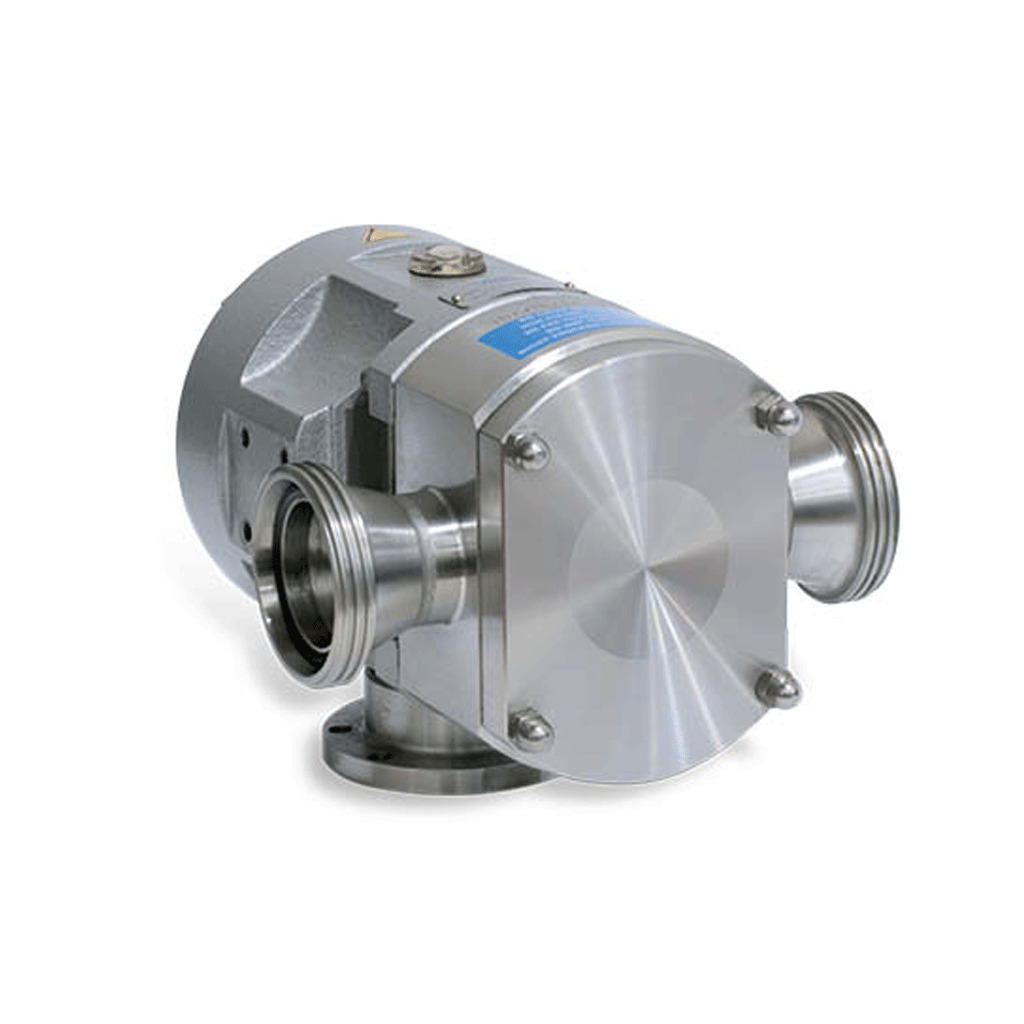
When the absolute priority is the delicate handling of the product, the FL-PRL lobe pump is the undisputed queen. Unlike gears, the lobes do not come into physical contact with each other or with the pump casing, which drastically reduces friction wear and, above all, the mechanical stress on the honey.
This design is fundamental to avoid the incorporation of air bubbles and to handle extreme viscosities of up to 100,000 cP.
By having larger volumetric chambers, the lobe pump can move large flow rates at very low speeds, ensuring that the honey reaches packaging with its original brightness and transparency . Furthermore, its sanitary architecture allows for total cleaning without disassembly, being fully compatible with CIP (Cleaning In Place) systems.
Thermal management: The importance of the heating jacket
Regardless of the chosen technology, an efficient industrial honey pump must consider temperature. Cold honey is practically impossible to pump without overloading the motor or breaking the mechanical seals.
For this reason, InoxMIM pumps optionally incorporate heating jackets on both the front cover and the body. These systems allow for the circulation of hot water or steam, or the installation of electric heaters, to warm the hydraulic block before startup.
This reduces the viscosity of the product located in the head, facilitating a smooth start and preventing crystallized honey from blocking the rotating elements. Controlled thermal management is the secret to continuous pumping that does not degrade color or flavor (avoiding excess HMF).
Selection criteria to optimize your production line
At this point, the question is not which technology is the best in absolute terms, but which industrial honey pump best adapts to the specific architecture of your installation. Feeding a precision filler is not the same as the bulk emptying of a tanker truck or a maturation tank.
The engineering decision must be based on a balance between hydraulic performance, ease of maintenance, and initial investment (CAPEX). At InoxMIM, we analyze each project individually to ensure that the equipment works at its point of maximum efficiency, avoiding oversizing or, worse, premature wear due to a poor technological choice.
When to choose a lobe pump over a gear pump?
To facilitate technical selection, we have synthesized the most common usage scenarios in the syrup and bee product industry:
Finally, it is fundamental to remember that both technologies benefit greatly from the use of a frequency inverter. This component allows for the adjustment of the rotation speed of the industrial honey pump in real time, adapting to changes in viscosity caused by variations in ambient temperature or the honey batch itself, thus protecting both the motor and the product integrity.
Frequently asked questions about industrial honey pumps
Contact us