
The Challenge of Preserving “Liquid Gold” During Transfer
Extra Virgin Olive Oil (EVOO) is probably one of the most sensitive and complex products to handle in the food industry. Unlike other refined vegetable oils, extra virgin olive oil is a “fruit juice” that contains an unsaponifiable fraction rich in volatile compounds, polyphenols, and natural antioxidants that define its organoleptic profile.
Any error in the design of the process line, especially in the choice of the olive oil transfer pump, can ruin months of careful cultivation and extraction.
In the modern oil mill, the movement of oil from decanters to storage tanks, and from these to the filtering and packaging plant, must be carried out under an unnegotiable technical premise: absolute respect for the product’s structure. Inadequate pumping is not just a matter of hydraulic efficiency; it is a direct threat to the fruity, bitter, and pungent attributes that give the oil its commercial category and market value.
Table of contents
Critical Factors that Degrade Oil: Oxidation, Emulsion, and Temperature
Olive oil has three major enemies during mechanical handling: oxygen, violent agitation, and heat.
Firstly, lipid oxidation is the most feared degradation process. If the olive oil transfer pump does not guarantee total sealing or if the impeller design generates turbulence, it facilitates the incorporation of microbubbles of air into the oil mass. This dissolved oxygen accelerates the formation of peroxides, initiating a rancidity process that drastically shortens the product’s shelf life and destroys its primary aromas.
Secondly, emulsion occurs when oil is pumped at excessive speeds or through high-shear technologies. If the oil contains traces of moisture (common after extraction), aggressive pumping can “emulsify” that water with the oil, causing turbidity and greatly hindering subsequent decantation and filtering processes.
Finally, the temperature generated by mechanical friction within the pump is critical. A local thermal increase, caused by a pump operating outside its efficiency point or with excessively tight tolerances, can volatilize the esters responsible for the aroma, leaving a flat oil lacking personality.
Why Low Shear is Vital for Extra Virgin Olive Oil
The concept of low shear (low shear) is the cornerstone of transferring superior quality oils. Shear is the mechanical stress that occurs when fluid layers move at different speeds within the pump, literally “breaking” or stressing the oil’s molecules and suspensions.
To preserve organoleptic properties, the olive oil transfer pump must move the fluid as smoothly and laminarly as possible. Positive displacement technologies or helical turbine centrifugal pumps are ideal for this purpose, as they transport the oil in volumetric chambers or through helical paths that do not agitate the product.
By reducing shear stress, we prevent the degradation of polyphenols and maintain the oil’s transparency. Gentle pumping ensures that the components that give the intense green color and herbaceous nuances remain stable, ensuring that the consumer receives a product with all the guarantees of freshness and original quality from the oil mill.
Sanitary Materials and Finishes: Ensuring Purity in the Oil Mill
The chemical integrity of olive oil also depends on the nature of the surfaces it comes into contact with. Oil is an organic solvent that can absorb foreign flavors or react with certain metals if the pumping technology is not appropriate.
At InoxMIM, the manufacturing of any olive oil transfer pump is governed by maximum hygiene standards:
Related articles:
InoxMIM Pumping Technology for the Olive Oil Sector
The selection of an olive oil transfer pump is not a generic decision; it depends directly on the stage of the process (extraction, decantation, or packaging) and the product’s density (filtered oil, unfiltered oil, or decantation sludge).
At InoxMIM, we have developed various pumping technologies that share a common denominator: the protection of the oil’s sensory quality. Below, we present a comparison of the most efficient solutions for the modern oil mill:
| Model / Series | Technology | Max Flow Rate | Main Benefit for Oil | Recommended Application |
|---|---|---|---|---|
| FL-PRL | Sanitary Lobe | Up to 70 m³/h | Viscosity handling without mechanical contact | Oil mill, pomace, and dense oils |
| FL-RF | Flexible Impeller | Up to 30 m³/h | Self-priming (-0.6 bar) and Reversible | Cellar, tank emptying, and packaging |
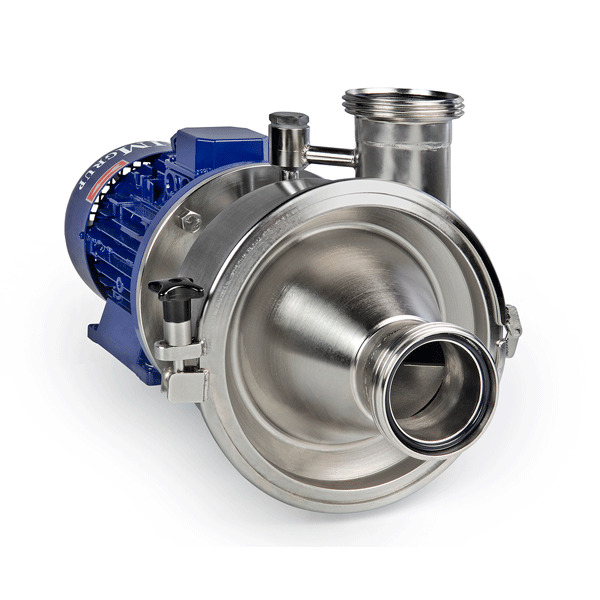
Helical Turbine Pumps: The Perfect Balance Between Flow Rate and Gentleness
The FL-CH series represents the vanguard in olive oil transfer pumps for large cellars. Its hybrid design combines the advantages of a centrifugal pump with the gentleness of a positive displacement pump. The secret lies in its helical turbine impeller, which acts similarly to an Archimedes’ screw.
This design allows the oil to flow through the pump axially and laminarly, eliminating the aggressive turbulence typically generated by conventional flat-blade centrifugal pumps. By not “beating” the oil, the probability of emulsion and the incorporation of dissolved oxygen are drastically reduced.
It is the preferred option for master oil millers to feed filtration systems, where a constant and pulsation-free flow is required to optimize the lifespan of filter plates or earths.
Lobe Pumps: Versatility for Dense Oils and By-products
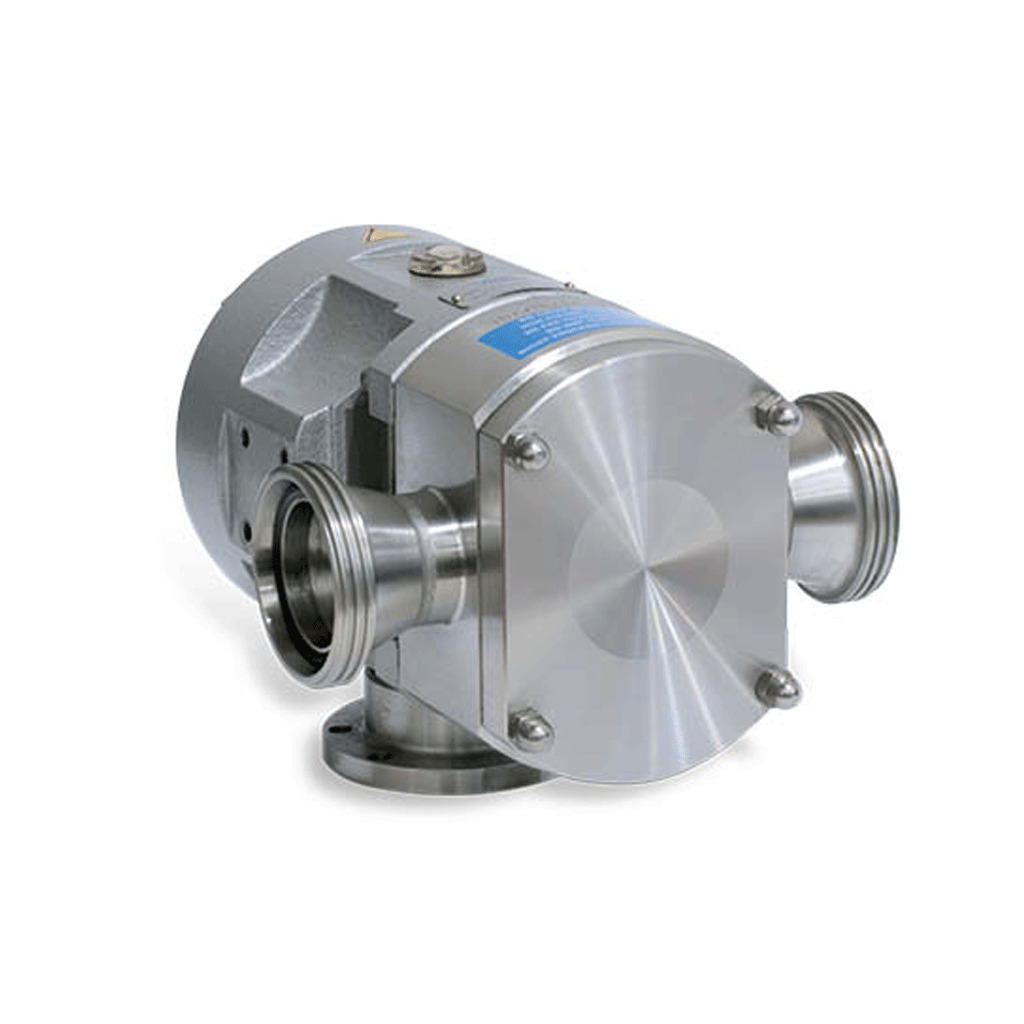
When the oil mill process requires moving fluids with higher viscosity or containing small traces of solids (such as freshly extracted unfiltered oil or pomace), the FL-PRL lobe pump is the most robust engineering solution. Manufactured entirely from AISI 316L stainless steel, its operating principle is based on two lobes that rotate in opposite directions without touching.
This absence of direct mechanical contact between the rotors and the pump body minimizes friction wear and ensures extremely gentle transfer. By operating at low revolutions, the FL-PRL series is ideal for handling viscous by-products without clogging.
Furthermore, its sanitary architecture allows for thorough cleaning at the end of the season, preventing old oil residues from oxidizing inside the hydraulic block and contaminating the new oil from the next harvest.
Flexible Impeller Pumps: Self-priming and Portability in the Cellar
For daily cellar operations, such as emptying tanks or transferring between tanks of different heights, the flexible impeller pump (FL-RF Series) is the most versatile tool. Its main technical advantage is its impressive self-priming capability, allowing oil to be lifted from lower levels without the need to prime the pump beforehand.
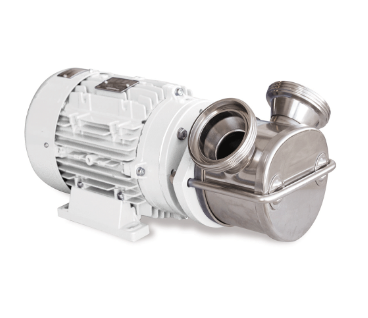
The impeller, made of food-grade elastomers, deforms against the casing, creating a powerful vacuum and a positive displacement flow. It is a reversible technology, which allows the flow direction to be inverted with a simple switch to recover oil from hoses at the end of the transfer.
Due to its compact size, it is usually mounted on a stainless steel trolley with a frequency inverter, making it the indispensable mobile equipment for any oil mill seeking versatility and efficiency in its daily transfers.
Process Optimization in the Oil Mill and Packaging Plant
Efficiency in an oil mill is not only measured by the volume of oil extracted but by the ability to maintain that performance without sacrificing quality. A poorly selected olive oil transfer pump can become an operational “bottleneck” or, worse, a source of degradation due to mechanical fatigue of the product.
Process optimization requires understanding that oil changes its rheological properties and sensitivity as it progresses through the different production stages.
Moving oil freshly out of the horizontal decanter (decanter), which still contains traces of moisture and microparticles in suspension, is not the same as feeding a glass bottle packaging line where precision and the total absence of air are critical factors.
Therefore, the integration of frequency inverters and pressure monitoring systems in InoxMIM pumps allows each stage to be carried out with maximum hydraulic smoothness.
Equipment Selection According to Stage: Extraction, Decantation, Filtration, or Dispatch
By segmenting the use of each olive oil transfer pump according to these functional needs, the oil mill not only protects its machinery investment but also safeguards the sensory profile of its EVOO, ensuring that the final consumer perceives all the positive attributes that the olive offered at the time of harvest.
Frequently Asked Questions about Our Olive Oil Transfer Pumps
Contact us