
Beyond simple agitation: The physics of dispersion
Reconstituting powdered milk, whey, proteins (WPC/WPI), or preparing brines is not a simple mixing process; it is a fluid engineering challenge.
The goal is not only to wet the powder, but to achieve complete, instant hydration of each particle before the outer layer gels and forms an impermeable barrier. In the plant, using traditional methods often results in long process times and inconsistent mixing quality.
For production managers, efficiency is measured by the ability to incorporate large volumes of solids (powdered milk, cocoa, pectins) into a liquid phase without compromising the final rheology or clogging in-line filters. This is where the physics of dispersion dictates that conventional agitation is insufficient; controlled shear is required.
Table of contents
The issue of colloidal agglomerates (“fish-eyes”)
The most common and costly defect in dairy reconstitution is the formation of “fish-eyes”. This occurs when the powder comes into contact with the liquid in a disorderly manner: the outer surface of the agglomerate hydrates quickly, forming a gelatinous, sticky layer that prevents water from penetrating the dry core.
These lumps not only reduce raw material yield (wasting expensive product), but also pose a bacteriological risk, as the dry core may not reach the proper pasteurization temperature. Breaking up these agglomerates after the fact requires excessive agitation times or the use of colloid mills that can damage protein chains due to excessive temperature.
Control of aeration and foam during solids incorporation
Milk and its derivatives are protein matrices with a high foaming capacity. Vertical agitators operating with a surface vortex tend to introduce air into the mix (uncontrolled Venturi effect). The micro-aeration generated is detrimental to the process:
An efficient mixing system must be able to incorporate the solid below the liquid level or via induced vacuum in a confined chamber, minimizing atmospheric exposure.
Limitations of conventional vertical agitators in dissolution
Although a vertical agitator (such as a marine propeller or an axial turbine) is excellent for maintaining tank homogeneity, it lacks the localized kinetic energy required to disperse difficult powders instantly. Its function is to move mass, not to generate the high shear required to “tear” the powder structure upon contact with water.
Trying to dissolve pectins or powdered milk simply by increasing the RPM of a vertical agitator often results in a deep vortex, greater air entrainment, and incomplete dissolution that forces endless recirculation, drastically reducing the line’s OEE (Overall Equipment Effectiveness).
Related articles:
Suction mixing and high-shear technology
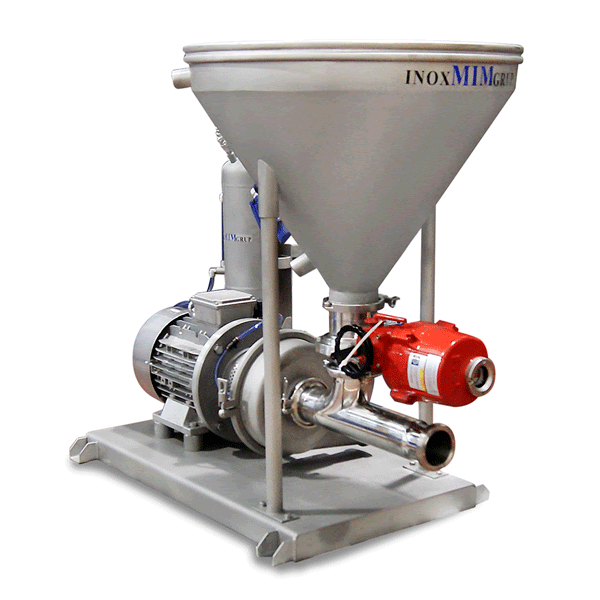
To solve the issue of hydrating hydrophobic or hard-to-disperse powders, at InoxMIM we have developed the solid-liquid mixer series EMTB Blender.
Unlike conventional agitators, this equipment does not rely on gravity to incorporate the solid; it uses the kinetic energy of the fluid to generate a controlled vacuum system.
The optimized impeller design and suction system make it possible to produce homogeneous mixes, completely eliminating lumps, even in high-viscosity products or those prone to rapid agglomeration.
The key is to confine the point of contact between the powder and the liquid in a high-shear mixing chamber, avoiding contact with ambient air.
Venturi principle: Vacuum suction and intimate solid-liquid contact
The efficiency of the EMTB Blender is based on the Venturi effect. The base fluid is driven at high speed through the mixing chamber, generating a depression (suction) in the solid injection zone.
- Controlled suction: The powder is drawn from the hopper directly into the heart of the liquid flow.
- Instant hydration: Upon contact in a zone of high turbulence and pressure, each powder particle is immediately surrounded by liquid, preventing them from touching each other and forming “fish-eyes”.
- Caking prevention: This system prevents the surface wetting and caking that typically occurs when powder is poured onto the static surface of a tank.
Mixing chamber design and particle size reduction
In blenders, most of which consist only of a turbine, the shear is generated by the turbine rotating at high speed and dissolution is completed when the product impacts the housing walls. For most easy-to-add products, a blender is sufficient, whereas dispersing pectins, thickening gums, and difficult products requires an in-line emulsifier.
Once the solid has been incorporated into the liquid flow, the mixture is subjected to violent mechanical action. In in-line emulsifiers and in some models in our blender range, the rotor drives the product against the stator slots, applying high shear stress that dissolves remaining agglomerates and reduces particle size.
This process ensures that, after a recirculation cycle (if necessary, via the regulating valve), a fully homogeneous and stable mixture is obtained. The equipment is manufactured entirely with wetted parts in AISI 316L stainless steel with a sanitary finish, ensuring the chemical and mechanical resistance required for the dairy industry.
Range versatility: From the vertical model (EMTB V) to the tabletop skid (EMTE)
We understand that each plant has different ergonomic and process requirements. Therefore, EMTB technology is available in different design configurations. Below is a technical comparison to facilitate selection of the appropriate model:
| Model | Configuration | Power (kW) | Ideal application | Operational advantage |
|---|---|---|---|---|
| EMTB | Horizontal in-line with tangential inlet | 2.2 – 7.5 | Fixed installation under a tank or in a recirculation loop. | Compact solution for integration into existing lines that prevents product wetting |
| EMTB-Y | Horizontal in-line | 2.2 – 7.5 | Fixed installation under a tank or in a recirculation loop with a Y diffuser to maximize the Venturi effect. | Compact solution for integration into existing lines. |
| EMTB V | Vertical | 2.2 – 4.0 | Limited spaces where footprint is critical. | Vertical design that facilitates complete gravity drainage. |
| EMTE | Tabletop skid | 4.0 – 18.5 | Manual operations with bags (powdered milk, cocoa). | Ergonomics: Portable table with an optimized working height for the operator. |
All models allow quick disassembly via CLAMP connections to facilitate inspection and manual cleaning if required, although they are designed for CIP cleaning.
Why choose an EMTB series blender?
Downtime spent on manually dissolving lumps or on complex cleaning is unacceptable. Implementing high-shear blenders such as the EMTB series transforms a discontinuous, slow process into a smooth operation, drastically reducing batch preparation times.
By integrating solids addition via vacuum suction into a recirculation loop, the need for pallet lifting systems over tank manways is eliminated, minimizing occupational risks and the product’s exposure to the plant environment.
Reduced batch times and guaranteed CIP/SIP cleaning
The sanitary design of InoxMIM equipment is intended to meet the most demanding cleaning protocols without the need for disassembly. EMTB and EMTE models ensure effective CIP (Clean In Place) cleaning thanks to their self-draining internal geometry and polished surface finishes that prevent protein or sugar adhesion.
For critical applications, such as the production of infant formula or pharmaceutical injectables, the sealing system is configurable. While the single mechanical seal S/S/EPDM is the robust standard for most dairy applications, we offer the option to install a double, cartridge mechanical seal cooled by thermosiphon, ensuring tightness and enabling safe SIP (Sterilize In Place) sterilization cycles. In addition, quick-release CLAMP connections facilitate immediate visual inspection of critical points if quality protocols require it.
Milk and whey reconstitution does not allow variability. The presence of undissolved lumps or excessive air entrainment are not only aesthetic issues; they are process failures that affect the density, texture, and shelf life of the final product. With suction-based solid-liquid mixing technology, we ensure that each powder particle receives the exact mechanical treatment required for complete hydration.
If your plant is facing “fish-eye” issues, excessive mixing times, or uncontrolled foam, our technical department is available to size the mixing skid or blender that fits your flow rate and viscosity.
Contact us