MD/MDN Vertical Agitator
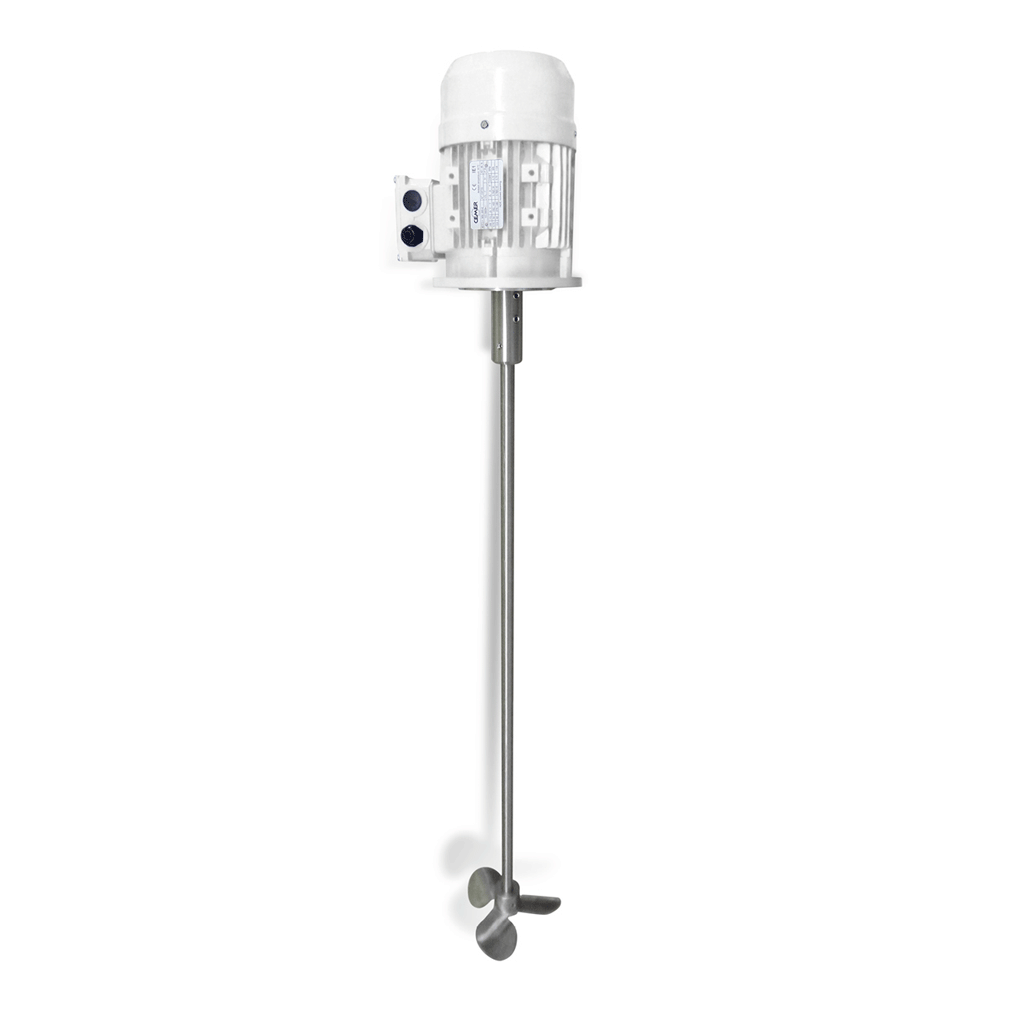
InoxMIM's most agile and efficient solution for the preparation of reagents and low-viscosity mixtures. The MD (electric motor) and MDN (pneumatic motor) series vertical agitators stand out for their ultra-compact design and low structural weight, making them the ideal technical choice for direct installation on high-density polyethylene (PEHD) tanks and small-sized tanks.
Thanks to their high-speed direct drive, they ensure optimal kinetic energy transfer, drastically reducing dilution, dissolution, and homogenization times in water treatment plants and general industry.
Technical specifications
- Drive Type: Direct electric motor (MD Series) standard (4, 6 or 8 poles) or pneumatic motor drive (MDN Series) for specific environments, especially explosive atmospheres.
- Fixing and Mounting: Agitator base configured with a standardized IEC motor flange, facilitating its integration.
- Basic Hydraulic Design: Equipped as standard with an axial flow MARINE type propeller.
- Material in Contact with Product: Shaft and impeller made of high corrosion-resistant AISI 316 (1.4404) stainless steel.
- Maintenance: Simple parts architecture with quick coupling system for assembly and disassembly without special tools.
- Sealing: Basic direct system and optionally with Lip Seal and Lip Seal + V-ring.
The MD and MDN series vertical agitators represent InoxMIM's high-performance entry-level range within its agitation catalog. They have been developed from the ground up in fluid engineering to offer a robust, reliable, and economically efficient solution for the preparation of chemical reagents and simple mixtures in small and medium-volume tanks.
The operating principle of these units is based on the high rotational speed of their impeller. Lacking a gearmotor, the shaft rotates at the nominal motor speed (typically 750, 1,000, 1,500 rpm depending on the motor poles). This high kinetic energy is transmitted to the fluid through the MARINE type propeller, which generates a purely axial flow pattern. This hydrodynamic profile forcefully pushes the liquid to the bottom of the tank, where it impacts and rises along the tank walls, creating global recirculation that eliminates dead zones and prevents the sedimentation of heavy particles.
At a mechanical structural level, one of the greatest engineering successes of this series is the connection system between the motor and the shaft. Instead of using solid shafts that increase product cost and complicate replacement, InoxMIM uses a precision rigid coupling sleeve. This element not only safely transmits torque but also greatly simplifies routine maintenance tasks.
If the motor breaks down, the plant operator can separate it from the agitator shaft in a matter of minutes, replace it with a standard IEC motor from the market, and resume production, reducing downtime to an absolute minimum. Furthermore, the modular design ensures the interchangeability of agitation components, providing the plant with great versatility if mixing conditions change in the future.
- Pneumatic Drive (MDN Series): For installations operating in classified explosion-risk areas (ATEX zones) where a conventional electric motor would pose a risk, or in plants with a stable compressed air network, the MDN variant uses a pneumatic motor. This also allows for easy variation of agitation speed by regulating the incoming air flow, without the need for expensive electronic frequency converters.
- Special Materials and Coatings: Although AISI 316 stainless steel is the industry standard, the treatment of certain waters requires the dosing of highly aggressive reagents (such as ferric chloride or hydrochloric acid). For these scenarios, InoxMIM offers the manufacture of shafts and propellers in superior alloys or, more commonly, the application of protective coatings (such as ebonite, Halar, or epoxy resins) that shield the metal against severe corrosion, extending the equipment's lifespan for years.
- Sealing Systems: When agitating fluids that emit corrosive vapors or gases, there is a risk of these rising along the shaft and attacking the motor bearings. To prevent this, the agitator can be equipped with a V-Ring seal, an elastomeric seal that creates an effective physical barrier between the tank atmosphere and the drive mechanics.
- Plant Integration: The series can be supplied as a "turnkey" project, including the polyethylene or stainless steel tank, protective motor covers (ideal for outdoor installations), electrical control panels, and manual or automatic lifting systems. These lifters are especially useful when the agitator is used in mobile containers (IBC type) and needs to be frequently removed.
- IEC 160 Flange Configuration: Designed for lower power models. It features an outer base diameter (Dimension A) of 160 mm and a distance between drill centers (Dimension B) of 130 mm. Its low weight allows it to be installed directly on the tank plastic without requiring complex metal reinforcements.
- IEC 200 Flange Configuration: The intermediate standard for more demanding dissolution processes. It has an outer diameter of 200 mm and a distance between fixing holes of 165 mm, providing a wider support base to absorb vibrations inherent in high revolutions.
- IEC 250 Flange Configuration: The most robust structure in the series for higher horsepower motors. With a 250 mm outer diameter and 215 mm between anchors, it guarantees absolute rigidity even when longer shafts are configured to reach the bottom of taller cylindrical tanks.
- Water Treatment Sector (WWTP / DWTP / Desalination Plants): This is their natural habitat. MD equipment is commonly installed on PEHD tanks for the intensive preparation of vital chemical reagents for water clarification. They are essential for the homogenization of lime slurries, the rapid dilution of inorganic coagulants (alumina sulfate, polyaluminum chloride - PAC), the preparation of sodium hypochlorite solutions for disinfection, and in neutralization tanks for pH adjustment (mixing acids and caustic soda). Their speed ensures that the reagent reaches a homogeneous concentration before being injected into the main line by dosing pumps.
- Food and Beverage Industry: Although not designed for highly viscous products, they are the perfect choice for preliminary or additive stages. They are widely used in the preparation of brines for the meat or canning industry, ensuring the complete dissolution of salt in water without leaving precipitates at the bottom. They are also used for the rapid dissolution of sugars in the creation of simple syrups, the mixing of liquid colorants, and the homogenization of additives or preservatives before their incorporation into the food process flow.
- General Chemical Industry: Ideal for blending chemicals with water-like viscosity, formulating liquid agricultural fertilizers, and preparing solvents, where the turbulence generated by the MARINE propeller ensures perfect reaction or dilution in record time.
If you need personalized advice, contact us
Related products
SB/SBR/SBN Vertical Agitators
MD/MDN Vertical Agitator