
The Technical Challenge of Mixing Immiscible Liquids
In highly demanding sectors such as the food, cosmetic, and pharmaceutical industries, one of the most complex and common unit operations is the creation of emulsions.. Formulating a high-end facial cream, an industrial mayonnaise, or a medicinal ointment requires the intimate mixing of two fluids that, by their very thermodynamic nature, repel each other: an aqueous phase and a lipid phase (oil).
Overcoming interfacial tension between these two immiscible liquids requires the application of a large amount of mechanical energy. If a conventional agitator is used (such as a propeller or a turbine), temporary dispersion will be achieved, but the generated droplets will be too large.
This is where high-shear technology (high shear) comes into play, with the in-line homogenizer being the fundamental piece of engineering to ensure that the final product maintains its rheological, organoleptic, and textural properties unchanged throughout its shelf life.
Table of contents
Emulsion Instability: Coalescence and Phase Separation
To understand why advanced homogenization equipment is needed, we must first analyze the physical behavior of emulsions. When oil and water are forced to mix, a dispersion of small droplets of one phase within the other is created. However, this state is thermodynamically unstable.
Over time, and governed by Stokes’ Law, droplets tend to rise or fall depending on their density (a phenomenon known as creaming or sedimentation). As these droplets collide with each other, they merge to form increasingly larger droplets, a destructive physical process called coalescence. If coalescence is not stopped, the product will eventually break down completely, separating into two distinct liquid layers and ruining the production batch.
To prevent this separation, in addition to using surfactants or emulsifiers in the formulation, it is a non-negotiable mechanical requirement to reduce the droplet size to a micrometric or sub-micrometric scale. By achieving an extremely tiny droplet, the contact surface between the phases multiplies exponentially and the force of gravity ceases to have a significant effect on them, thus achieving a perfectly stable emulsion in the long term. This level of micronization is impossible to achieve with traditional agitation.
What is an In-line Homogenizer and How Does the Rotor-Stator System Work?
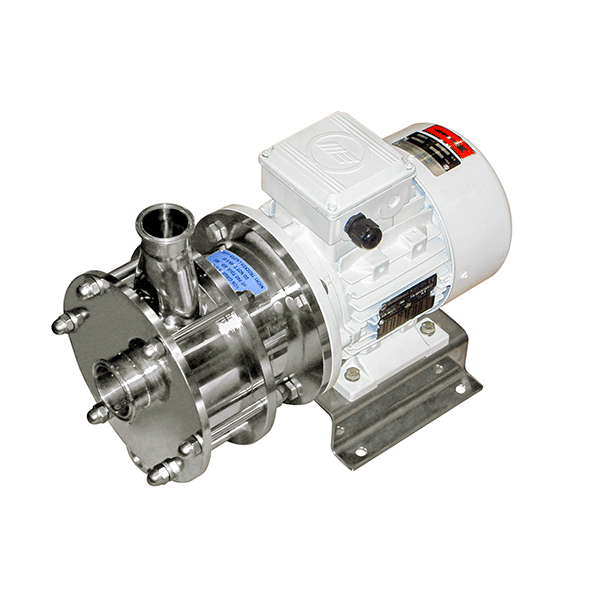
An in-line homogenizer is a precision pumping and mixing unit designed to be installed directly into the process piping of the plant. Its thermofluid-dynamic core is based on a rotor-stator mechanism, a mechanical architecture designed to generate extreme levels of shear.
Operation is divided into three millimetric phases that occur in fractions of a second:
Advantages of Continuous Flow Processing vs. Batch Systems
Historically, many formulations have been emulsified in batch systems, using a bottom-entry or immersion homogenizer inside a large tank. Although this technique is valid, it presents problems of inefficiency and variability. In a tank, it is mathematically impossible to guarantee that 100% of the fluid has passed exactly the same number of times through the high-shear zone.
The result is a wide particle size distribution (PSD), where highly crushed droplets coexist with larger ones that managed to “dodge” the head. The implementation of an in-line homogenizer transforms the process, providing critical operational advantages for plant engineering:
Related articles:
High-Shear Solutions for the Sanitary Industry
When the challenge of emulsion is transferred to sectors such as the manufacture of pharmaceutical injectables, high-end cosmetics, or infant nutrition, thermofluid-dynamic performance must necessarily go hand in hand with total asepsis.
InoxMIM in-line homogenizers are designed under the strictest sanitary engineering guidelines, ensuring that the enormous mechanical energy applied to the fluid never compromises its safety.
The operational technical specifications of our range of in-line homogenizers are detailed below:
| Model | Power (kW) | Suction Connection | Discharge Connection | Contact Material | Shaft Sealing |
|---|---|---|---|---|---|
| EML 1.5-3000 | 1.5 kW | DN50 | DN40 | AISI 316 Stainless Steel | Single / Double mechanical seal |
| EML 4-3000 | 4.0 kW | DN65 | DN50 | AISI 316 Stainless Steel | Single / Double mechanical seal |
| EML 7.5-3000 | 7.5 kW | DN80 | DN65 | AISI 316 Stainless Steel | Single / Double mechanical seal |
| EML 11-3000 | 11.0 kW | DN80 | DN65 | AISI 316 Stainless Steel | Single / Double mechanical seal |
| EML 15-3000 | 15.0 kW | DN80 | DN65 | AISI 316 Stainless Steel | Single / Double mechanical seal |
| EML 22-3000 | 22.0 kW | DN100 | DN80 | AISI 316 Stainless Steel | Single / Double mechanical seal |
| EML 30-3000 | 30.0 kW | DN100 | DN80 | AISI 316 Stainless Steel | Single / Double mechanical seal |
Micrometric Control: The Importance of Slotted Head Design
The heart of any in-line homogenizer is its head. However, there is no single design that fits all fluids. The ability of a unit to achieve a stable emulsion of oils and aqueous phases depends critically on the stator geometry and the profile of its slots or perforations.
In the design of these heads, high-precision machined tolerances are maintained between the moving rotor and the fixed stator. Depending on the rheology of the product (viscosity, density) and the target droplet size, the plant engineer must select the appropriate head:
By forcing the fluid through these restrictive geometries at high peripheral speeds, the shear area is multiplied exponentially, ensuring that even the most resistant oil droplets are fractured at the micrometric level before leaving the chamber.
Hygienic Design, Mechanical Sealing, and Regulatory Compliance (FDA)
In the sanitary industry, any corner where fluid can stagnate is a potential focus for bacterial proliferation. Therefore, the exterior and interior architecture of the in-line homogenizer must be impeccable.
All components in contact with the product are manufactured in AISI 316L stainless steel, a material that offers exceptional resistance to corrosion from organic acids and chlorides present in many foods and cosmetics.
Furthermore, internal surfaces undergo mechanical polishing and electropolishing processes to reach a surface roughness (Ra) of less than 0.8 µm (or 0.4 µm in critical pharmaceutical applications), strictly complying with FDA (Food and Drug Administration) standards and EHEDG (European Hygienic Engineering & Design Group) design guidelines.
A vital aspect is the drive shaft sealing system. To prevent product leaks to the outside and, more seriously, the entry of pathogens to the inside, these units employ sanitary mechanical seals.
Depending on the thermal or chemical aggressiveness of the product, they are configured with single seals or cooled double mechanical seals, equipped with silicon carbide or tungsten friction faces and elastomeric gaskets (EPDM, FKM) with food-grade certification.
Total Integration in Cleaning and Sterilization Processes (CIP/SIP)
One of the great advantages of processing emulsions in-line compared to old tank systems is the drastic reduction in downtime for cleaning. A well-designed in-line homogenizer lacks “dead zones” ( dead legs).
This absence of nooks and crannies allows the equipment to be integrated naturally and without disassembly into the plant’s automated cleaning protocols. During a CIP (Cleaning In Place) cycle, the line’s own centrifugal pump circulates caustic and acid solutions at high speed through the rotor-stator head.
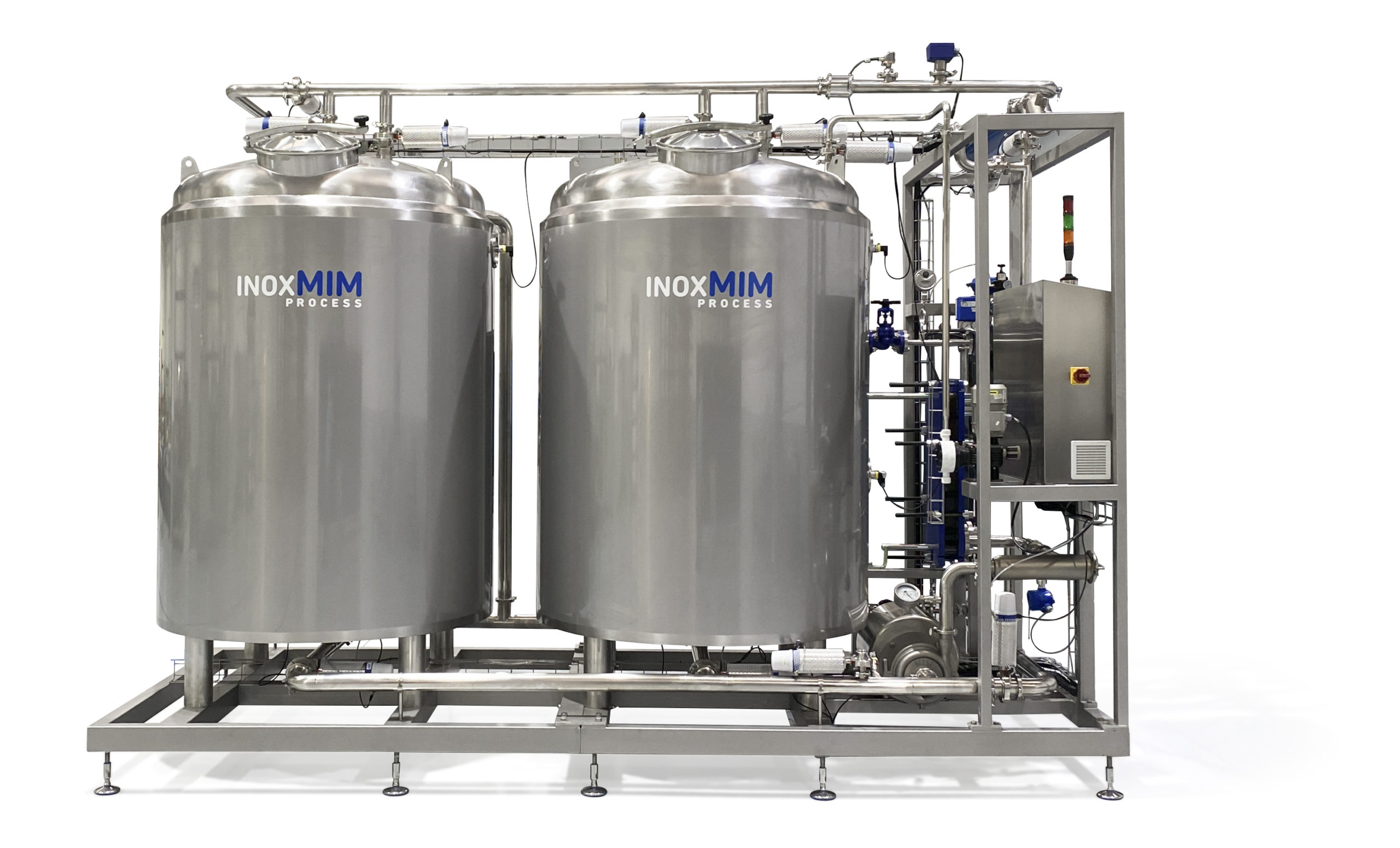
The extreme turbulence generated by the homogenizer itself acts as an active self-cleaning system, removing any fatty residue or oil film embedded in the stator slots.
Subsequently, for pharmaceutical or aseptic packaging processes, the equipment withstands SIP (Sterilization In Place) cycles without deformation, allowing the injection of live steam at high temperatures (up to 140ºC) to ensure total sterility of the hydraulic block before starting a new production batch.
Key Applications in High-Demand Sectors
The implementation of an in-line homogenizer radically transforms the production efficiency of the plant. Since these units not only emulsify but also have the capacity to pump the product (thanks to the specific design of their discharge impellers), the design of the piping network (Piping & Instrumentation Diagram) is greatly simplified.
This mechanical versatility allows for a totally homogeneous product, without lumps, and by working in a closed circuit, oxidation or contamination by contact with ambient air is avoided.
From Fine Cosmetics (Creams and Lotions) to Food (Emulsified Sauces)
In the cosmetic and pharmaceutical industry, texture, absorption, and long-term stability are non-negotiable. Body lotions, makeup bases, sunscreens, and medicinal ointments are, for the most part, oil-in-water (O/W) or water-in-oil (W/O) emulsions.
If these phases separate in the final customer’s packaging, the product is automatically rejected. For formulations with high viscosity or distant densities, InoxMIM has developed the EMLT variant, equipped with custom-designed multi-tooth heads. This design exerts extreme shear stress that prevents phase separation, achieving absolutely stable sub-micrometric dispersions that would be impossible to achieve with a standard propeller agitator.
On the other hand, in the food industry, the EML series shines in the continuous production of emulsified sauces, mayonnaises, dairy creams, and brine preparation. By forcing the passage of the aqueous phase (egg, water, vinegar) and the oil phase (oil) through the slotted stator, a dense, shiny, and stable emulsion is generated in the mouth (mouthfeel).
Furthermore, these units are extremely effective for the dissolution and dispersion of solids in liquids, as occurs when incorporating powders, thickening gums (xanthan, guar), pectins, or sugars that would otherwise form impermeable lumps (known as fish eyes) floating inside the mixing tanks.
Frequently Asked Questions
Contact us