
Our rotary lobe pump catalog
InoxMIM’s FL–PRL rotary lobe pumps are designed for transferring high-viscosity products, sensitive products, or products with solids in suspension, maintaining product integrity and ensuring a constant volumetric flow.
Their positive displacement principle using synchronized lobes provides uniform, pulsation-free pumping with low shear, making them an ideal solution for food, cosmetic, pharmaceutical, and chemical processes that require high standards of hygiene and control.
Manufactured in AISI 316L stainless steel, with tri-lobe or bi-lobe lobes, these pumps are notable for their volumetric efficiency, their CIP/SIP sanitary design, and their ability to work with fluids of highly diverse viscosities, from emulsions to semi-solid pastes.
Lobe pumps
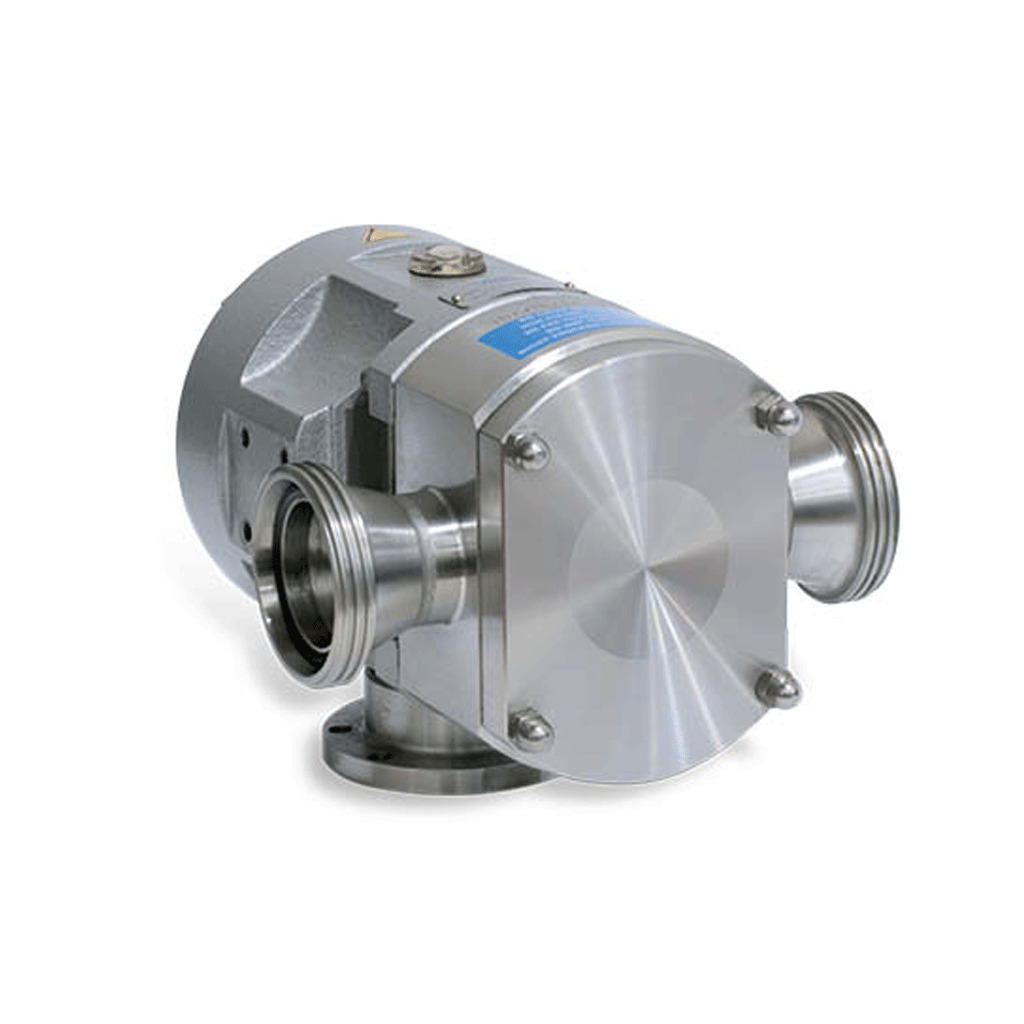
Design and technical characteristics
The FL–PRL series has been developed under criteria of robustness, cleanliness, and stable hydraulic performance, combining mechanical precision with a certified hygienic architecture.
The external synchronizing gear and oversized bearings ensure perfect alignment of the lobes, preventing contact between them and reducing wear even under variable load conditions.
Main features:
- Flow rate proportional to the speed of rotation, ideal for controlled dosing or transfer processes.
- Reversible operation, which allows filling and emptying operations with the same unit.
- High working pressure (up to 12 bar) with minimal pulsation and no cavitation.
- Double or single mechanical seals, cooled or sealed, adaptable to product and temperature.
- Interchangeable lobes in stainless steel or elastomers, depending on the nature of the fluid.
- Total compatibility with CIP cleaning and SIP sterilization, without the need for disassembly.
- DIN 11851, Clamp, or SMS sanitary connections, available in different configurations.

Operational and design advantages
Most common industrial applications
Food industry
FL–PRL pumps are widely used in food production lines that work with products sensitive to temperature, pressure, or shear.
Its gentle drive prevents phase separation, aeration, and texture degradation, ensuring the preservation of the food’s organoleptic properties.
They are especially suitable for pumping jams, sauces, yogurts, creams, syrups, purees, or semi-solid masses, even with the presence of soft particles.
In processing plants, they are usually integrated into:
- Filling or dosing systems for aseptic packaging and bags.
- Recirculation circuits to heat exchangers, pasteurizers, or homogenizers.
- Mixing or transfer processes between tanks with flow control via frequency variator.
Thanks to their sanitary design, compatible with CIP/SIP, they can remain operational in extended shifts with automated cleaning, reducing downtime and ensuring traceability in each batch.


Cosmetic and pharmaceutical industry
In the cosmetic and pharmaceutical sectors, lobe pumps are essential for production processes where homogeneity, hygiene, and pressure control are critical.
They allow the handling of creams, ointments, lotions, emulsions, or gels with high viscosity, maintaining the consistency and stability of the product during pumping.
Their sealed mechanical closure and polished surface finish ensure contamination-free pumping and compatibility with sterile manufacturing environments or under a controlled atmosphere.
Among its most common applications are:
- Feeding reactors or mixers in cosmetic and ointment manufacturing lines.
- Dosing emulsions or gels in automatic filling stations.
- Recirculation in cooling or homogenization processes, where flow precision and the absence of pulsations are essential.
Their compact design allows easy integration into GMP facilities, complying with international FDA and EHEDG regulations.
Chemical industry
FL–PRL pumps offer excellent performance in chemical applications that require mechanical resistance, volumetric stability, and compatibility with technical fluids.
They can work with adhesives, resins, silicones, paints, detergents, cleaning products, or suspensions with fine non-abrasive particles, maintaining flow without cavitation or backflow.
Their high volumetric efficiency makes them ideal for precise dosing processes, mixture recirculation, and continuous feeding of reactors or batch reactors.
In addition, they can be equipped with pressurized double seals and heated chambers, allowing operation with products that require thermal control or sealing against explosive atmospheres. These features, together with their ATEX compatibility, make them a reliable solution for chemical, cosmetic, and industrial product treatment plants.