
Our catalog of helical turbine centrifugal pumps
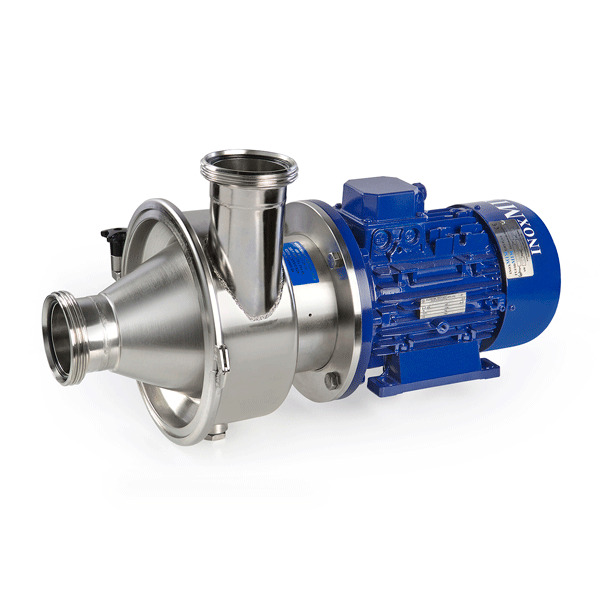
InoxMIM helical turbine centrifugal pumps are designed for the controlled transfer of products with solid particles or high sensitivity to shear, ensuring continuous, smooth pumping without product deterioration.
This model, belonging to the FluidMIM line, combines the efficiency of a centrifugal pump with the solid handling capacity of positive displacement equipment, offering stable performance even in fluids with suspended solids or aerated mixtures.
Manufactured entirely in AISI 316L stainless steel, FL–CH pumps are widely used in the food, wine, and dairy industries, where respect for product integrity and ease of cleaning are critical requirements.
Its hygienic design and optimized hydraulic geometry allow it to work with low energy consumption, minimal cavitation, and high reliability in continuous operation.
Helical turbine centrifugal pumps
Design and operation
The helical impeller is the key element of this model. Its open profile, of high-performance helical geometry generates a continuous flow that keeps solid particles suspended without causing water hammer or hydraulic collapses.
In this way, the fluid is gently propelled, preserving its physical structure and avoiding damage to fragile solids such as fruits, vegetables, or dairy products.
The FL–CH pump operates at low revolutions (1,500 rpm) with discharge pressures between 5 and 18 m.w.c. and maximum flow rates of up to 160 m³/h, depending on the model.
Its stable hydraulic behavior makes it ideal for transfers, recirculations, and tank feeds where the balance between flow, pressure, and smoothness of propulsion is fundamental.

Operational and design advantages
Most common industrial applications
Food industry
In the food sector, FL–CH pumps are especially valued for their ability to handle delicate products without altering their texture, shape, or organoleptic quality.
Its smooth and continuous propulsion prevents particle breakage, allowing the pumping of foods with suspended solids or semi-solid structures.
They are used, among other applications, for:
- Transfer of products with structured solids, such as olives, legumes, chopped fruits, or vegetables in suspension.
- Processes for making sauces, purees, and creams with solid particles, where the homogeneity of the final product depends on hydraulic control.
- Transfer of sensitive dairy products, such as curd, yogurt, cheese, or cream, maintaining their structure without destabilizing proteins or breaking the fat phase.
Their hygienic design and compatibility with CIP/SIP systems allow them to be integrated into production lines that require automated cleaning without disassembly, ensuring compliance with FDA and EHEDG regulations.

Wine industry
In the wine industry, FL–CH pumps offer exceptional performance during the pumping over, racking, and fermentation stages.
Their smooth and stable propulsion allows moving musts, wines, and solid suspensions without breaking skins or oxidation, preserving the aromatic and phenolic compounds essential for wine quality.
These pumps are used in:
- Controlled fermentation pump-overs, ensuring a homogeneous mixture of solids and balanced oxygenation.
- Transfers between tanks, where the product must be moved without turbulence or aeration.
- Clarification and filtration processes, in which a uniform flow favors controlled sedimentation and filtration efficiency.
The FL–CH pump has become a key tool in wineries and wine cooperatives that seek smoother, more efficient processes with less mechanical maintenance.
Chemical and cosmetic applications
In the chemical and cosmetic sectors, FL–CH pumps demonstrate their effectiveness in the transport of non-homogeneous, viscous products or products with non-abrasive solid particles, guaranteeing a constant flow without phase segregation.
They are ideal for suspensions, emulsions, detergents, pastes, or gels that require controlled handling, without degradation of their physical structure.
Application examples:
- Pumping liquid or concentrated detergents with solid additives.
- Transfer of cosmetic emulsions, such as creams or lotions with microspheres or exfoliating particles.
- Chemical dispersion or reaction processes that require constant flow at low speed to avoid phase separation.
In addition, their structural robustness, their compatibility with double seals, and their possibility of ATEX certification make them suitable for industrial environments with risk of flammable vapors or electrostatic charges.